When you first encounter microgravity, you have the following feelings:
- Nausea
- Disorientation
- Headache
- Loss of appetite
- Congestion
The longer you stay in microgravity, the more your muscles and bones weaken.
These sensations are caused by changes in various systems of the human body. Let's take a closer look at how your body responds in a weightless environment.
Spacesick
The nausea and disorientation that you feel are like that sinking feeling in your stomach when you experience a drop on a roller coaster ride -- only you have that falling feeling for several days. This is the feeling of space sickness, or space motion sickness, which is caused by conflicting information that your brain receives from your eyes and the vestibular organs located in your inner ear.
Your eyes can see which way is up and down inside the shuttle. However, because your vestibular system relies on the downward pull of gravity to tell you which way is up (and in which direction you are moving), it does not function in microgravity. So your eyes may tell your brain that you are upside-down, but your brain does not receive any interpretable input from your vestibular organs.
Your confused brain then produces the nausea and disorientation, which in turn may lead to vomiting and loss of appetite. Fortunately, after a few days, your brain adapts to the situation by relying solely on the visual inputs, and you begin to feel better. NASA has issued medication patches to help astronauts deal with the nausea until their bodies adapt.
Puffy Face and Bird Legs
In microgravity, your face will feel full and your sinuses will feel congested, which may contribute to headaches as well as space motion sickness. You feel the same way on Earth when you bend over or stand upside down, because blood rushes to your head.
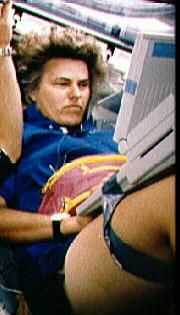
On Earth's surface, gravity pulls on your blood, causing significant volumes to pool in the veins of your legs. Once you encounter microgravity, the blood shifts from your legs into your chest and head. Your face tends to get puffy and your sinuses swell, as shown below. The fluid shift also shrinks the size of your legs.
Shifts in Your Blood and Bodily Fluids
When the blood shifts to the chest, your heart increases in size and pumps more blood with each beat. Your kidneys respond to this increased blood flow by producing more urine, much like they do after you drink a large glass of water. Also, the increase in blood and fluid decreases anti-diuretic hormone (ADH) secretion by the pituitary gland, which makes you less thirsty. Therefore, you do not drink as much water as you might on Earth.
Overall, these two factors combine to help rid your chest and head of the excess fluid, and in a few days, your body's fluid levels are less than what they were on Earth's surface. Although you still have a slightly puffy head and stuffy sinuses, it is not as bad after the first couple of days.
When you return to Earth's gravity, those fluids will be pulled back down to your legs and away from your head, causing you to feel faint when you stand up. But you will also begin to drink more, and your fluid levels will return to normal in a couple of days.
Space Anemia
As your kidneys eliminate the excess fluid, they also decrease their secretion of erythropoietin, a hormone that stimulates red blood-cell production by bone marrow cells. The decrease in red blood-cell production matches the decrease in plasma volume so that the hematocrit (percentage of blood volume occupied by red blood cells) is the same as on Earth.
Once you're back on our planet, your erythropoietin levels will increase, as will your red blood-cell count. But for now, let's keep you in a microgravity environment to learn more about the effects of free-fall on the human body.
Weak Muscles
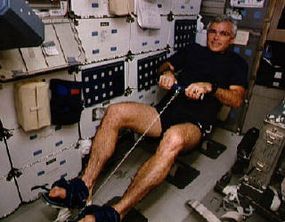
When you are in microgravity, your body adopts a "fetal" posture -- you crouch slightly, with your arms and legs half-bent in front of you. In this position, you do not use many of your muscles, particularly those muscles that help you stand and maintain posture (anti-gravity muscles). As your stay aboard the International Space Station lengthens, your muscles change. The mass of your muscles decreases, which contributes to the "bird leg" appearance.
The muscle fiber types change from slow-twitch to fast-twitch. Your body no longer needs slow-twitch endurance fibers, such as those used in standing. Instead, more fast-twitch fibers are needed as you push yourself quickly off of space station surfaces. The longer you stay on the station, the less muscle mass you will have. This loss of muscle mass makes you weaker, presenting problems for long-duration space flights and upon returning home to Earth's gravity.
Brittle Bones
On Earth, your bones support the weight of your body. The size and mass of your bones are balanced by the rates at which certain bone cells (osteoblasts) lay down new mineral layers and other cells (osteoclasts) chew up those mineral layers. In microgravity, your bones do not need to support your body, so all of your bones, especially the weight-bearing bones in your hips, thighs and lower back, are used much less than they are on Earth.
The result is that the size and mass of these bones continue to decrease as long as you remain in zero gravity, at a rate of approximately 1 percent per month. These changes in bone mass make your bones weak and more likely to break upon your return to Earth's gravity.
In addition to weak bones, your blood's calcium concentration increases slightly as your bones get chewed up by osteoclasts. Your kidneys must get rid of the excess calcium, which makes them susceptible to forming kidney stones.