In the exploration of the western frontier of the Unites States, pioneers had forts or staging points where they departed to venture into the unexplored territories. Similarly, in the early 20th century, pioneering space scientists, such as Hermann Oberth, Konstantin Tsiolkovsky, Hermann Noordung and Wehrner von Braun, dreamed of vast space stations orbiting the Earth. Like forts in the western frontier, these scientists envisioned space stations as staging points for the exploration of outer space.
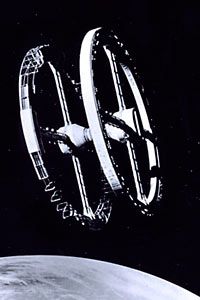
Wehrner von Braun, the architect of the American space program, integrated space stations into his long-term vision of U.S. space exploration. To accompany von Braun's numerous space articles in popular magazines, artists drew concepts of space stations. These articles and drawings helped fuel public imagination and interest in space exploration, which was essential to establishing the U.S. space program (for more, see How the Space Race Worked).
Advertisement
In these space station concepts, people lived and worked in outer space. Most of the stations were wheel-like structures that rotated to provide artificial gravity. Like any port, ships traveled to and from the station. The ships carried cargo, passengers, and supplies from Earth. The departing flights went to Earth, the Moon, Mars and beyond. As you know, this general concept is no longer merely a vision of scientists, artists and science fiction authors. But what steps have been taken to build such orbiting structures? While mankind has not yet realized the full visions of von Braun and others, there have been significant strides in building space stations.
The United States and Russia have had orbiting space stations since 1971. The first space stations were the Russian Salyut program, the U.S. Skylab program and the Russian Mir program. And since 1998, the United States, Russia, the European Space Agency, Canada, Japan and other countries have been building and operating the International Space Station (ISS) in Earth orbit. With the ISS, humans have been living and working in outer space for more than 10 years.
In this article, we'll examine the early space station programs, the uses of space stations, and the future role of space stations in the exploration of outer space. But first, let's consider more fully why many people think we should be building space stations.