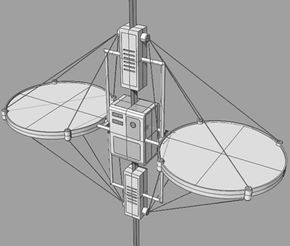
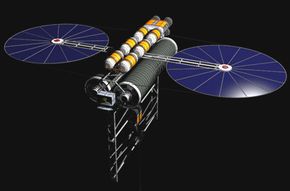
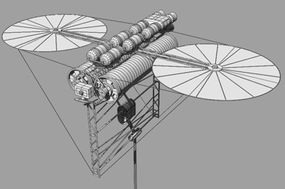
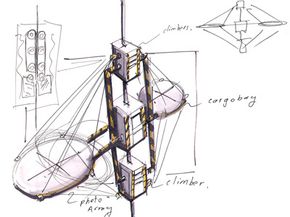
The lifter, seen in this artist's concept, will be able to carry as much as 13 tons of cargo into space, propelled by laser beams. See more space exploration pictures.
Photo courtesy LiftPort Group
When the Space Shuttle Columbia lifted off on April 12, 1981, from Kennedy Space Center, Fla., to begin the first space shuttle mission, the dream of a reusable spacecraft was realized. Since then, NASA has launched more than 100 missions, but the price tag of space missions has changed little. Whether it is the space shuttle or the non-reusable Russian spacecraft, the cost of a launch is approximately $10,000 per pound ($22,000 per kg).
A new space transportation system being developed could make travel to Geostationary Earth Orbit (GEO) a daily event and transform the global economy.
Advertisement
A space elevator made of a carbon nanotubes composite ribbon anchored to an offshore sea platform would stretch to a small counterweight approximately 62,000 miles (100,000 km) into space. Mechanical lifters attached to the ribbon would then climb the ribbon, carrying cargo and humans into space, at a price of only about $100 to $400 per pound ($220 to $880 per kg).
In this article, we'll take a look at how the idea of a space elevator is moving out of science fiction and into reality.
A counterweight at the end of the space elevator will keep the carbon-nanotubes ribbon taut.
Photo courtesy LiftPort Group
To better understand the concept of a space elevator, think of the game tetherball in which a rope is attached at one end to a pole and at the other to a ball. In this analogy, the rope is the carbon nanotubes composite ribbon, the pole is the Earth and the ball is the counterweight. Now, imagine the ball is placed in perpetual spin around the pole, so fast that it keeps the rope taut. This is the general idea of the space elevator. The counterweight spins around the Earth, keeping the cable straight and allowing the robotic lifters to ride up and down the ribbon.
Under the design proposed by LiftPort, the space elevator would be approximately 62,000 miles (100,000 km) high. LiftPort is one of several companies developing plans for a space elevator or components of it. Teams from across the world are set to compete for the $400,000 first prize in the Space Elevator Games at the X Prize Cup in October 2006 in Las Cruces, New Mexico.
Advertisement
The centerpiece of the elevator will be the carbon nanotubes composite ribbon that is just a few centimeters wide and nearly as thin as a piece of paper. Carbon nanotubes, discovered in 1991, are what make scientists believe that the space elevator could be built. According to Dr. Bradley Edwards of the Spaceward Foundation, "Previously the material challenges were too great. But now we're getting close with the advances in creating carbon nanotubes and in building machines that can spin out the great lengths of material needed to create a ribbon that will stretch up into space" [ref].
Under some early plans, leftover construction materials will be used to form the counterweight.
Photo courtesy LiftPort Group
Carbon nanotubes have the potential to be 100 times stronger than steel and are as flexible as plastic. The strength of carbon nanotubes comes from their unique structure, which resembles soccer balls. Once scientists are able to make fibers from carbon nanotubes, it will be possible to create threads that will form the ribbon for the space elevator. Previously available materials were either too weak or inflexible to form the ribbon and would have been easily broken.
"They have very high elastic modulus and their tensile strength is really high, and that all points to a material that, in theory, should make a space elevator relatively easy to build," said Tom Nugent, research director, LiftPort Group.
A ribbon could be built in two ways:
Long carbon nanotubes -- several meters long or longer -- would be braided into a structure resembling a rope. As of 2005, the longest nanotubes are still only a few centimeters long.
Shorter nanotubes could be placed in a polymer matrix. Current polymers do not bind well to carbon nanotubes, which results in the matrix being pulled away from the nanotubes when placed under tension.
Once a long ribbon of nanotubes is created, it would be wound into a spool that would be launched into orbit. When the spacecraft carrying the spool reaches a certain altitude, perhaps Low Earth Orbit, it would begin unspooling, lowering the ribbon back to Earth. At the same time, the spool would continue moving to a higher altitude. When the ribbon is lowered into Earth's atmosphere, it would be caught and then lowered and anchored to a mobile platform in the ocean.
The ribbon would serve as the tracks of a sort of railroad into space. Mechanical lifters would then be used to climb the ribbon to space.
How the Space Elevator Measures Up
If built, the ribbon will represent a modern world wonder, and will be the tallest structure ever built. Consider that the world's tallest freestanding tower in 2005 is the CN Tower, which rises 1,815 feet 5 inches (553.34 meters) over Toronto, Canada. The space elevator would be 180,720 times taller than the CN Tower!
The 62,000-mile (100,000-km) long space elevator would rise far above the average orbiting height of the space shuttle (115-400 miles/185-643 km). In fact, it would equal nearly a fourth of the distance to the moon, which orbits the Earth at 237,674 miles (382,500 km).
Advertisement
Riding a Space Elevator to the Top
The climbers at each end of the lifter will roll up the ribbon at a rate of about 200 mph.
Photo courtesy LiftPort Group
While the ribbon is still a conceptual component, all of the other pieces of the space elevator can be constructed using known technology, including the robotic lifter, anchor station and power-beaming system. By the time the ribbon is constructed, the other components will be nearly ready for a launch sometime around 2018.
Lifter
The robotic lifter will use the ribbon to guide its ascent into space. Traction-tread rollers on the lifter would clamp on to the ribbon and pull the ribbon through, enabling the lifter to climb up the elevator.
Advertisement
Anchor Station
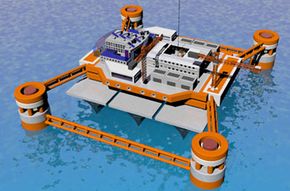
The space elevator will originate from a mobile platform in the equatorial Pacific, which will anchor the ribbon to Earth.
Counterweight
At the top of the ribbon, there will be a heavy counterweight. Early plans for the space elevator involved capturing an asteroid and using it as a counterweight. However, more recent plans like those of LiftPort and the Institute for Scientific Research (ISR) include the use of a man-made counterweight. In fact, the counterweight might be assembled from equipment used to build the ribbon including the spacecraft that is used to launch it.
Power Beam
The lifter will be powered by a free-electron laser system located on or near the anchor station. The laser will beam 2.4 megawatts of energy to photovoltaic cells, perhaps made of Gallium Arsenide (GaAs) attached to the lifter, which will then convert that energy to electricity to be used by conventional, niobium-magnet DC electric motors, according to the ISR.
Once operational, lifters could be climbing the space elevator nearly every day. The lifters will vary in size from five tons, at first, to 20 tons. The 20-ton lifter will be able to carry as much as 13 tons of payload and have 900 cubic meters of space. Lifters would carry cargo ranging from satellites to solar-powered panels and eventually humans up the ribbon at a speed of about 118 miles per hour (190 km/hour).
Advertisement
Space Elevator Maintenance
The space elevator ribbon will be anchored to a mobile platform in the equatorial Pacific. As part of a system to help the elevator avoid orbital debris, the mobile platform can be repositioned.
Photo courtesy LiftPort Group
At a length of 62,000 miles (100,000 km), the space elevator will be vulnerable to many dangers, including weather, space debris and terrorists. As plans move forward on the design of the space elevator, the developers are considering these risks and ways to overcome them. In fact, to make sure there is always an operational space elevator, developers plan to build multiple space elevators. Each one will be cheaper than the previous one. The first space elevator will serve as a platform from which to build additional space elevators. In doing so, developers are ensuring that even if one space elevator encounters problems, the others can continue lifting payloads into space.
Avoiding Space Debris
Like the space station or space shuttle, the space elevator will need the ability to avoid orbital objects, like debris and satellites. The anchor platform will employ active avoidance to protect the space elevator from such objects. Currently, the North American Aerospace Defense Command (NORAD) tracks objects larger than 10 cm (3.9 inches). Protecting the space elevator would require an orbital debris tracking system that could detect objects approximately 1 cm (.39 inches) in size. This technology is currently in development for other space projects.
Advertisement
"Our plans are to anchor the ribbon to a mobile platform in the ocean," said Tom Nugent, of LiftPort. "You can actually move your anchor around to pull the ribbon out of the way of satellites."
Repelling Attacks
The isolated location of the space elevator will be the biggest factor in lowering the risk of terrorist attack. For instance, the first anchor will be located in the equatorial Pacific, 404 miles (650 km) from any air or shipping lanes, according to LiftPort. Only a small portion of the space elevator will be within reach of any attack, which is anything 9.3 miles (15 km) or below. Further, the space elevator will be a valuable global resource and will likely be protected by the U.S. and other foreign military forces.
Advertisement
Space Elevator Impact
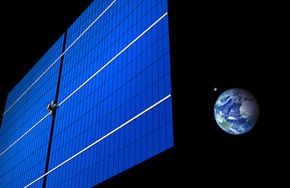
An artist's concept of the solar view.
Photo courtesy LiftPort Group
The potential global impact of the space elevator is drawing comparisons to another great transportation achievement -- the U.S. transcontinental railroad. Completed in 1869 at Promontory, Utah, the transcontinental railroad linked the country's east and west coasts for the first time and sped the settlement of the American west. Cross-country travel was reduced from months to days. It also opened new markets and gave rise to whole new industries. By 1893, the United States had five transcontinental railroads.
The idea of a space elevator shares many of the same elements as the transcontinental railroad. A space elevator would create a permanent Earth-to-space connection that would never close. While it wouldn't make the trip to space faster, it would make trips to space more frequent and would open up space to a new era of development. Perhaps the biggest factor propelling the idea of a space elevator is that it would significantly lower the cost of putting cargo into space. Although slower than the chemically propelled space shuttle, the lifters reduce launch costs from $10,000 to $20,000 per pound, to approximately $400 per pound.
Advertisement
Current estimates put the cost of building a space elevator at $6 billion with legal and regulatory costs at $4 billion, according to Bradley Edwards, author of the "The Space Elevator, NIAC Phase II Final Report." (Edwards is also the Dr. Bradley Carl Edwards, President and Founder of Carbon Designs.) By comparison, the cost of the space shuttle program was predicted in 1971 to be $5.2 billion, but ended up costing $19.5 billion. Additionally, each space shuttle flight costs $500 million, which is more than 50 times more than original estimates.
The space elevator could replace the space shuttle as the main space vehicle, and be used for satellite deployment, defense, tourism and further exploration. To the latter point, a spacecraft would climb the ribbon of the elevator and then would launch toward its main target once in space. This type of launch would require less fuel than would normally be needed to break out of Earth's atmosphere. Some designers also believe that space elevators could be built on other planets, including Mars.
NASA funded Dr. Edwards' research for three years. In 2005, however, it only awarded $28 million dollars to companies researching the space elevator. Although it's still very interested in the project, for now it would prefer to sit back and wait for more concrete developments.
For lots more information on space elevators and related topics, check out the links on the next page.
Testing the Technology
In February 2006, the LiftPort Group announced that it successfully launched a platform using high-altitude balloons. These balloons kept the platform a mile in the air for six hours.
LiftPort plans to market the platform, named HALE (High Altitude Long Endurance), as a station for security cameras and cell phone and radio transmissions. [ref].