Spaceship, Heal Thyself

Nanotechnology and Space

In the next 20 years, a new industry called nanotechnology will cause significant changes in our lives. Nanotechnology involves creating very tiny machines or robots no larger than a few nanometers. A nanometer is just a billionth of a meter. These nanomachines will be able to manipulate atoms and fabricate materials at the atomic level. Because they can self-replicate, these tiny machines will make production of almost any product very cheap.

One of the products of nanotechnology might be nanomachines that can be released to repair materials by sucking in surrounding molecules to repair a crack. If a crack formed in a spacecraft's composite shell, nanorobots could be released to gather molecules around the spacecraft to repair the crack.

Before nanotechnology can take off, scientists must learn how to manipulate atoms. The next challenge will be to program these nanomachines to perform specific tasks. For more information, read How Nanotechnology Will Work.

Damage to a spaceship's hull often begins as tiny surface cracks, which are invisible to the eye. These micro-thin cracks can also form underneath the surface of the material, where they are hidden from sight. Once these cracks form, they will grow until the material weakens and breaks. In order to prevent these tiny cracks from spreading, a new material has been developed that will sense damage and mend itself instantly. This self-healing ability could significantly prolong the life of the spacecraft.

There are three parts to this new self-healing material:

  • Composite material - The bulk of the material is an epoxy polymer composite. Polymer composites are advanced materials that are made from carbon, glass or Kevlar and a resin, such as epoxy, vinyl ester or urethane.
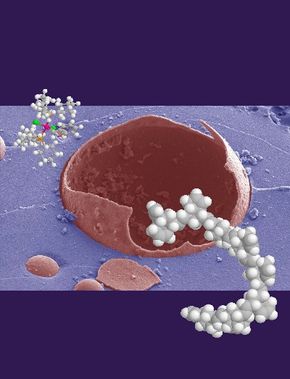
  • Microencapsulated healing agent - This is the glue that fixes the microcracks formed in the composite material. This healing agent is a fluid called dicyclopentadiene, or DCPD. This fluid is encapsulated tiny bubbles that are spread throughout the composite material. There are about 100 to 200 capsules per cubic inch.


    Photo courtesy University of Illinois
    Scanning electron microscope image of a ruptured microcapsule.

  • Catalyst - In order to polymerize, the healing agent must come into contact with a catalyst. A patented catalyst, called Grubbs' catalyst, is used for this self-healing material. It is important that the catalyst and healing agent remain separated until they are needed to seal a crack.

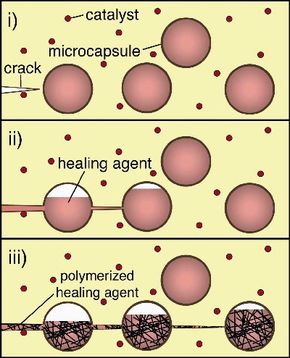
When a microcrack forms in the composite material, it will spread through the material. By doing so, this crack will rupture the microcapsules and release the healing agent. This healing agent will flow down through the crack and will inevitably come into contact with the Grubbs' catalyst, which initiates the polymerization process. This process will eventually bond the crack closed. In tests, the self-healed composite material regained as much as 75 percent of its original strength.


Photo courtesy University of Illinois
In this graphic you can see how the crack ruptures the microcapsules filled with a healing agent, which contacts the catalyst to bond the crack closed.

The market for this kind of self-healing material goes far beyond spacecraft. Approximately 20 million tons of composite material is used every year for engineering, defense projects, offshore oil exploration, electronics and biomedicine. This self-healing material will show up in many everyday items, including polymer composite circuit boards, artificial joints, bridge supports and tennis rackets.