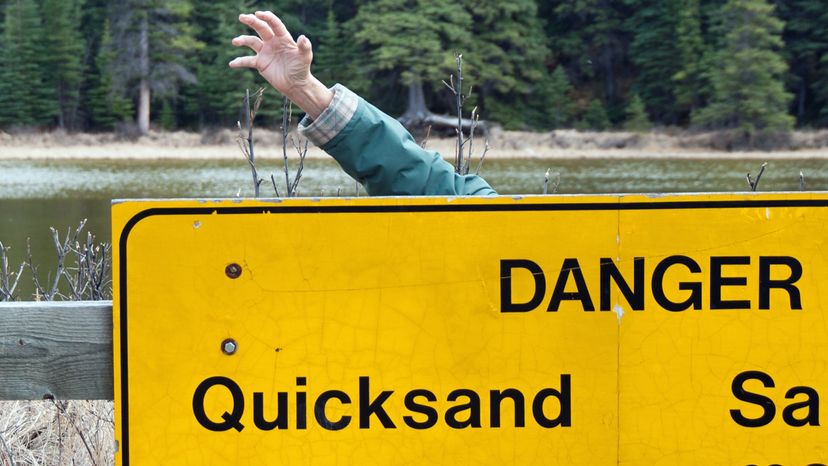
The more you struggle in quicksand the faster you will sink. If you just relax, your body will float in it because your body is less dense than the quicksand.
If you ever find yourself in a pit of quicksand, don't worry — it's not going to swallow you whole, and it's not as hard to escape from as movies like "Indiana Jones and the Kingdom of the Crystal Skull" might make you might think.
The average human body has a density of 62.4 pounds per cubic foot (1 g/cm3) and is able to float on water. Quicksand is denser than water — it has a density of about 125 pounds per cubic foot (2 g/cm3) — which means you can float more easily on quicksand than on water.
The key is to not panic. Most people who drown in quicksand, or any liquid for that matter, are usually those who panic and begin to make dramatic leg and arm movements.
Can You Drown in Quicksand?
It may be possible to drown in quicksand if you were to fall in over your head and couldn't get your head back above the surface, although it's rare for quicksand to be that deep. Most likely, if you fall in, you will float to the surface.
However, the sand-to-water ratio of quicksand can vary, causing some quicksand to be less buoyant.
"By the same token, if the quicksand were deep, as in up to your waist, it would be very difficult to extract yourself from a dense slurry, not unlike very wet concrete," said Rick Wooten, senior geologist for Engineering Geology and Geohazards for the North Carolina Geological Survey. "The weight of the quicksand would certainly make it difficult to move if you were in above your knees."
How to Get Unstuck
The worst thing to do is to thrash around in the sand and move your arms and legs through the mixture. You will only succeed in forcing yourself farther down into the liquid sandpit. The best thing to do is to make slow movements and bring yourself to the surface, then just lie back. You'll float to a safe level.
"When someone steps in the quicksand, their weight causes them to sink, just as they would if they stepped in a pond," Dumouchelle said. "If they struggle, they'll tend to sink. But, if they relax and try to lay on their back, they can usually float and paddle to safety."
When you try pulling one foot out of quicksand, you are working against a vacuum left behind by the movement, according to "The Worst-Case Scenario Survival Handbook." The authors of the book advise you to move as slowly as possible in order to reduce viscosity. Also, try spreading your arms and legs far apart and leaning over to increase your surface area, which should allow you to float.
While quicksand remains the hackneyed convention of bad adventure movies, there's very little to be afraid of in real life. As long as you keep a cool head in the situation, the worst result will be a shoe full of wet sand.