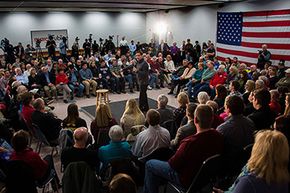
Presidential election primaries and caucuses are two very different methods of accomplishing the same basic thing. Simply put, they are both a means for each political party to let voters nationwide select their party's presidential nominee. More specifically, primaries and caucuses are means of selecting delegates (representatives of party members in each state) to send to the party's national convention.
At each party's national convention (held the summer before the presidential election), the party selects a presidential nominee based on how party delegates at the convention vote. The Republican and Democratic parties in each state select delegates based on either caucuses or a primary vote in that state -- the delegates are sent to represent voters in the state.
Advertisement
At the Democratic convention, the number of state delegates is proportional to the number of votes received in the state primary or caucus. The Republican Party allows states to use either a winner-take-all system (where the delegate or candidate with the most votes in a state's primary or caucus wins the right to be represented by all of the party's delegates at the national convention), or a proportional system. (States that hold early primaries must use a proportional allocation.)[source: GOP].
The total number of delegates each party can send to the national convention is again dictated by party rules. Usually the party determines the number of delegates through a formula factoring in state population, the number of elected officials in office, and that state's past support of party candidates.
Federal law doesn't dictate how states choose their delegates, so individual states decide what system to use. Most states use the primary system -- where voters statewide simply cast a vote for the candidate they support -- but some use the older caucus system.
The term caucus apparently comes from an Algonquin word meaning "gathering of tribal chiefs," and the main crux of the caucus system today is indeed a series of meetings. To see how this works, let's look at the Iowa caucuses -- the first "voting event" of the presidential election year.
Advertisement