If you have read How Bread Works, then you understand how the release of carbon dioxide by yeast can cause bread to rise. Many recipes, however, use no yeast. Things like muffins, biscuits, cakes and cookies usually use baking powder instead.
Baking powder is normally made of three different parts:
Advertisement
- An acid
- A base
- A filler of some sort
All three need to be dry powders that can be mixed together. For example, baking soda (a base), cream of tartar (an acid) and corn starch (the filler) are three common ingredients.
In school, you may have done the experiment where you mix baking soda (a base) and vinegar (an acid) and get a bubbling reaction. Baking powder works the same way. When you add water to baking powder, the dry acid and base go into solution and start reacting to produce carbon dioxide bubbles.
- Single-acting baking powder produces all of its bubbles when it gets wet.
- Double-acting baking powder produces bubbles again when it gets hot.
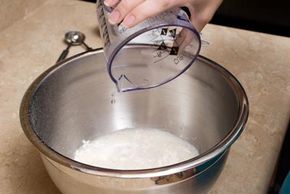
If you want to prove to yourself that this is how baking powder works, simply try mixing a teaspoon of baking powder into a cup of hot water. As long as the baking powder is fresh, you will definitely see the reaction!
Baking soda, also known as sodium bicarbonate, has the chemical formula NaHCO3. Cream of tartar, also known as tartrate salt, has the formula KHC4H4O6. The reaction is:
NaHCO3 + KHC4H4O6 ----> KNaC4H4O6 + H2O + CO2
NaHCO3 + KHC4H4O6 ----> KNaC4H4O6 + H2O + CO2
Some baking powders contain sodium aluminum sulfate: NaAl(SO4)2. The reaction there is:
NaAl(SO4)2 + 3 NaHCO3 ----> Al(OH)3 + 2 Na2SO4 + 3 CO2
NaAl(SO4)2 + 3 NaHCO3 ----> Al(OH)3 + 2 Na2SO4 + 3 CO2
Many recipes call simply for baking soda rather than baking powder. Usually these recipes use some kind of liquid acid like buttermilk or yogurt to react with the baking soda to produce the bubbles.
The reason why people often prefer baking powder to yeast is because yeast takes so long -- usually two to three hours -- to produce its bubbles. Baking powder is instant, so you can mix up a batch of biscuits and eat them 15 minutes later.
Now that you understand how baking powder works, you can understand two things you often see in recipes:
- Many recipes instruct you to mix all of the dry ingredients together and then add the liquid. That keeps the baking powder from reacting until the end of the mixing process.
- Many recipes tell you to mix only briefly -- just until the ingredients are moistened. That minimizes the escape of the gas from the batter. If you were to stir for a long time, the reaction would end and the stirring would have allowed the bubbles to escape.
For more baking tips and techniques, see the links on the next page.
Advertisement