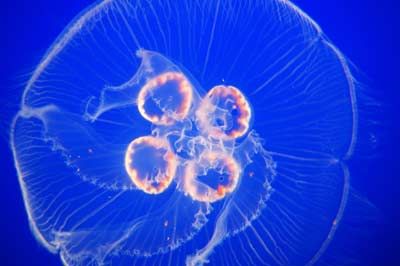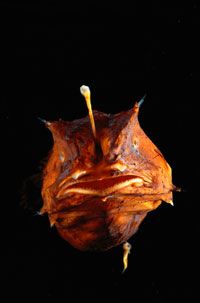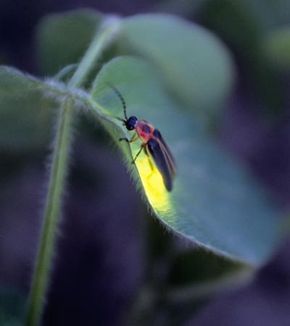
Fireflies or lightning bugs make light within their bodies. This process is called bioluminescence and is shared by many other organisms, mostly sea-living or marine organisms. Fireflies light up to attract a mate. To do this, the fireflies contain specialized cells in their abdomen that make light.
The cells contain a chemical called luciferin and make an enzyme called luciferase. To make light, the luciferin combines with oxygen to form an inactive molecule called oxyluciferin. The luciferase speeds up the reaction, which occurs in two steps:
Advertisement
- The luciferin combines with adenosine triphosphate (ATP), which is found in all cells, to form luciferyl adenylate and pyrophosphate (PPi) on the surface of the luciferase enzyme. The luciferyl adenylate remains bound to the enzyme: luciferin + ATP -------------> luciferyl adenylate + PPi
- The luciferyl adenylate combines with oxygen to form oxyluciferin and adenosine monophosphate (AMP). Light is given off and the oxyluciferin and AMP are released from the enzyme's surface: luciferyl adenylate + O2 -------------> oxyluciferin +AMP + light
The wavelength of light given off is between 510 and 670 nanometers (pale yellow to reddish green color). The cells that make the light also have uric acid crystals in them that help to reflect the light away from the abdomen. Finally, the oxygen is supplied to the cells through a tube in the abdomen called the abdominal trachea. It is not known whether the on-off switching of the light is controlled by nerve cells or the oxygen supply.
The luciferin-luciferase chemical reaction has been used for years to measure the amount of ATP produced in cells and by various chemical reactions. Recently, the gene (section of DNA coding for the protein) for the luciferase enzyme has been isolated, placed in the genes of other organisms, and used to follow the synthesis and/or expression of other genes (i.e. used as a reporter gene).
Advertisement