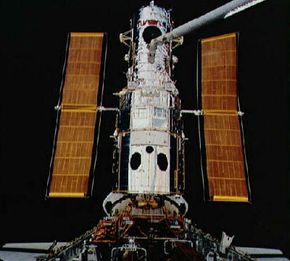
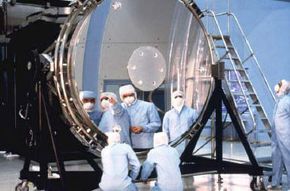
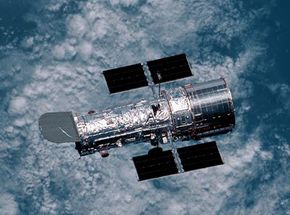
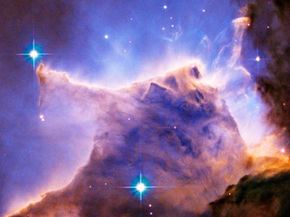
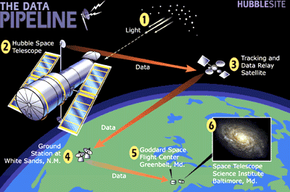
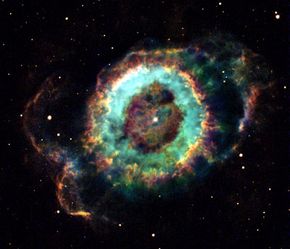
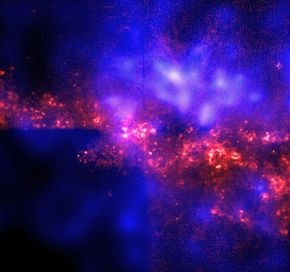
By looking at the different wavelengths, or the spectrum of light, of a celestial object, you can discern many of its properties. To do this, HST is equipped with several scientific instruments. Each instrument uses charge-coupled devices (CCDs) rather than photographic film to capture the light. The light detected by the CCDs is turned into digital signals, which are stored in onboard computers and relayed to Earth. The digital data are then transformed into amazing photos. Let's look at how each instrument contributes to those images.
Wide Field Camera 3 (WFC3)
The Wide Field Camera 3 (WFC3) is one of Hubble's primary imaging instruments. Featuring two channels, WFC3 captures both ultraviolet and infrared light, extending Hubble's observational reach. It uses two distinct rectangular chips for its ultraviolet/visible and infrared channels. Coupled with an extensive array of filters, WFC3 allows astronomers to glean intricate details about celestial objects, making it a pivotal upgrade from the Wide Field and Planetary Camera 2 (WFPC2) in Hubble's long-standing mission.
Near Infrared Camera and Multi-Object Spectrometer (NICMOS)
Often, interstellar gas and dust can block our vision of the visible light from various celestial objects. No problem: Hubble can see the infrared light, or heat, from the objects hidden in the dust and gas. To see this infrared light, HST has three sensitive cameras that make up the Near Infrared Camera and Multi-Object Spectrometer (NICMOS).
Space Telescope Imaging Spectrograph (STIS)
Besides illuminating a celestial object, the light emanating from that object can also reveal what it's made of. The specific colors tell us what elements are present, and the intensity of each color tells us how much of that element is present. The Space Telescope Imaging Spectrograph (STIS) separates the incoming colors of light much as a prism makes a rainbow.
In addition to describing the chemical composition, the spectrum can convey the temperature, density and motion of a celestial object. If the object is moving, the chemical fingerprint may shift toward the blue end (moving toward us) or the red end (moving away from us) of the spectrum. Unfortunately, the STIS lost power in 2004. It was repaired in 2009.
Advanced Camera for Surveys (ACS)
During a servicing mission in February 2002, astronauts added the Advanced Camera for Surveys (ACS), doubling the Hubble's field of view and replacing the Faint Object Camera, which served as the HST's telephoto lens.
The ACS, which sees visible light, was installed to help map the distribution of dark matter, detect the universe's most distant objects, search for massive planets and examine the evolution of clusters of galaxies. Scientists estimated it would last five years, and right on cue, an electrical shortage disabled two of its three cameras in January 2007.
Fine Guidance Sensors (FGSs)
The final instrument on board the HST is its Fine Guidance Sensors (FGSs), which point the telescope and precisely measure the positions and diameters of stars, as well as the separation of binary stars. The Hubble has three of these sensors overall; two to point the telescope and keep it fixed on its target, looking for "guide" stars in the HST field near the target. When each FGS finds a guide star, it locks on to it and feeds information back to the HST steering system to keep that guide star in its field. While two sensors are steering the telescope, one is free to make astrometric measurements (star positions). Astrometric measurements are important for detecting planets because orbiting planets cause the parent stars to wobble as they move across the sky.
Now you know how Hubble takes all those pictures. We'll learn about Hubble's other life as a spacecraft next.