17 Home Remedies for Ulcers

by the Editors of Consumer Guide

Cite This!
Please copy/paste the following text to properly cite this How Stuff Works article:

of Consumer Guide, the Editors.  "17 Home Remedies for Ulcers."  19 January 2007.  HowStuffWorks.com. <http://health.howstuffworks.com/home-remedies-for-ulcers.htm>  20 July 2008.
Health Videos
Health Videos
Not long ago, the stereotype of a person with ulcers was that of an aggressive, stressed-out businessman who worked long hours, surviving on three-martini lunches and too much spicy food. Many sufferers took a strange pride in that pain in the gut, considering it evidence of their ambition and selflessness.

What a letdown: Scientists proved in the 1980s that most ulcers are caused not by too much sweat and toil but ... by bacteria. What's more, while males were once thought to be the most common victims of this gastrointestinal menace, doctors now diagnose ulcers in women just as often as men. An estimated five million Americans have ulcers.

That doesn't mean stress, spicy foods, and alcohol aren't important. In fact, these and other lifestyle factors seem to worsen ulcers for some patients.
So, what can you do to avoid the burning sensation in your abdomen, nausea, or other symptoms related to ulcers?

In this article, we will discuss the causes and symptoms for ulcers. We'll also review traditional medical treatment as well as steps you can take at home to care for your digestive tract.
Let's get started with a look at the fundamentals of this condition.

A stressed-out, aggressive businessman is no longer the typical ulcer patient.

A stressed-out, aggressive businessman
is no longer the typical ulcer patient.
About  five million Americans,
 including women, have ulcers.

Definition

An ulcer is an erosion (open sore) on the surface of an organ or tissue. Ulcers most commonly erupt in the esophagus, stomach, and duodenum, in which case they are known as peptic ulcers. About five million Americans have peptic ulcers.

Causes

The problem begins, in most cases, with a spiral-shaped germ that seems to live for one purpose, digging holes in our stomachs. This bacterium, known as Helicobacter pylori (H. pylori for short), is very common: It's found in about half of all people under 60 years old in the United States. H. pylori never causes problems in most people, but in an unlucky minority, the bug burrows through the stomach's protective mucous coating. The bacteria and stomach acid irritate the sensitive lining beneath, causing ulcers to form.

In some cases, H. pylori isn't the villain, however. People who use nonsteroidal anti-inflammatory drugs (NSAIDs) and aspirin for pain relief over long periods can develop ulcers.

Heredity also plays an important role in contributing to ulcers. People who have a family history of ulcers seem to have a greater likelihood of acquiring the condition, as do people with type O blood. In addition, liver disease, rheumatoid arthritis, and emphysema are among the conditions that may increase vulnerability to ulcers.
Stomach and pancreatic cancers also can cause these sores to form.

Symptoms

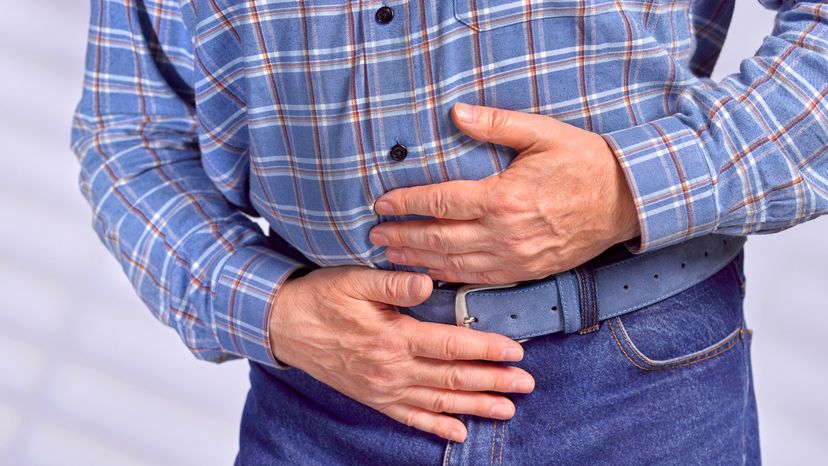
Ulcers can produce mild symptoms resembling heartburn or severe pain radiating throughout the upper portion of the body. The most common discomfort of ulcers is a burning sensation in the abdomen above the navel that may feel like hunger pangs. Pain comes about 30 to 120 minutes after eating or in the middle of the night when the stomach is empty. At this time, the acidic stomach juices are more apt to irritate the unprotected nerve endings in the exposed ulcer. Usually, pain subsides after eating or drinking something or taking an antacid to neutralize stomach acid.

Some people experience nausea, vomiting, and constipation. Blood in the feces (discoloring them black), blood in the vomit, extreme weakness, fainting, and excessive thirst are all signs of internal bleeding and may appear in more advanced cases.

Although ulcers are not usually life-threatening, they can cause serious damage if left untreated. Ulcers may erode nearby blood vessels and cause internal seepage of blood or hemorrhage (massive internal bleeding). A perforated ulcer may penetrate an adjoining organ, causing infection.

Diagnosis

Physicians diagnose peptic ulcers primarily on the basis of an X-ray examination after the patient has swallowed a special chalky substance called barium. The barium makes the digestive tract visible on X-ray film, allowing the doctor to view any abnormalities.

A second diagnostic technique is called an upper GI endoscopy (also called gastroscopy). The doctor inserts an endoscope (a flexible, lighted, tubelike instrument) through the mouth and down the esophagus to directly view the lining of the esophagus, stomach, and duodenum. An endoscopic examination and a biopsy (removal of a tissue sample for analysis) are necessary to confirm that an apparent ulcer is not actually a cancerous growth. Helicobacter pylori can be diagnosed with endoscopic biopsy or through a blood or breath test.

Treatment

Most ulcers caused by
H. pylori can be cured with a combination of antibiotics and acid-blocking drugs or bismuth subsalicylate (better known as Pepto Bismol). Unfortunately, even though this information has been widely disseminated in medical journals, some doctors still send ulcer patients home with little more than orders to take it easy, knock off the booze, and eat a bland diet. If you have ulcer-like symptoms, ask your doctor to perform tests that can determine whether you have the H. pylori bug, so that if prescription medications are appropriate for your condition, you get them.

Treatment of ulcers involves relieving the irritation so that healing is able to progress naturally. Antacids counteract stomach acid and relieve symptoms, but they can also cause complications. For example, sodium bicarbonate, a primary antacid ingredient, contains large amounts of sodium, which can aggravate kidney disease or high blood pressure.

For treatment of more problematic ulcers, a physician may prescribe other preparations to promote healing. Sucralfate coats the stomach, protecting it against gastric acid. Cimetidine, ranitidine, and other H2 blockers inhibit gastric acid production. Antibiotics and antacids are often prescribed to treat ulcers caused by infection with
H. pylori.

Although recent studies have shown that a bland diet is not necessary for ulcer management, such a diet is sometimes recommended until the acute symptoms disappear. Thereafter, many doctors suggest avoiding only those foods known to cause stomach distress.

Most ulcers heal within two to six weeks after treatment begins. To prevent recurrence, patients should continue to avoid cigarettes, alcohol, and any foods or substances that appear to cause irritation of the digestive tract lining.

When drug therapy and diet cannot cure an ulcer, surgical repair may be necessary. Surgery is appropriate for ulcers that recur or are life-threatening, such as perforated ulcers. Sometimes, surgeons remove a portion of the stomach and parts of the vagus nerve (which controls digestive secretions) to reduce stomach acid production. Usually, ulcers do not reappear after surgery.

Recently, endoscopic cautery (burning of tissue through an endoscope), direct injection of medications, and lasers have been quite successful in stopping bleeding, reducing the size of lesions, and correcting strictures (narrowing of the ducts due to scar formation). These procedures have spared many individuals from surgery.

Once they leave the doctor's office, ulcer patients can help their condition by watching their diet. Check out the next section for home remedies to take care of your digestive tract.

For more information on ulcer-causing stress and its harmful effects, visit the following:
  • To see all of our home remedies and the conditions they treat, go to our main Home Remedies page.
  • Among the many digestive problems that herbal remedies can relieve, herbs can also go a long way toward healing gastric ulcers. Find out how in Herbal Remedies for Ulcers.
  • Curious about what causes stress? Visit How Stress Works.
  • You can relieve some of stress' negative effects simply. For more information, read Home Remedies for Stress.
This information is solely for informational purposes. IT IS NOT INTENDED TO PROVIDE MEDICAL ADVICE. Neither the Editors of Consumer Guide (R), Publications International, Ltd., the author nor publisher take responsibility for any possible consequences from any treatment, procedure, exercise, dietary modification, action or application of medication which results from reading or following the information contained in this information. The publication of this information does not constitute the practice of medicine, and this information does not replace the advice of your physician or other health care provider. Before undertaking any course of treatment, the reader must seek the advice of their physician or other health care provider.

The brand name products mentioned in this publication are trademarks or service marks of their respective companies. The mention of any product in this publication does not constitute an endorsement by the respective proprietors of Publications International, Ltd. or HowStuffWorks.com, nor does it constitute an endorsement by any of these companies that their products should be used in the manner described in this publication.

Symptom Checker:

  Abdominal Bloating   Abdominal Fullness Prematurely Afte...   Abdominal Lumps   Abdominal Mass   Abdominal Pain   Abdominal Rigidity   Abdominal Sounds   Abdominal Swelling   Abnormal Posturing   Abnormal Tooth Shape   Abnormally Dark Or Light Skin   Absent Menstruation   Absent Thirst   Agitation   Ambiguous Genitalia   Ankle Pain   Appetite Decrease   Appetite Increase   Apraxia   Arachnodactyly   Armpit Lump   Autistic Behavior   Babinski's Reflex   Bed Wetting   Belching   Binge Eating   Blackheads   Bleeding Gums   Bleeding Into The Skin   Blindness   Blockage Of Leg Arteries   Blood In The Semen   Blood in Urine   Bloody Or Tarry Stools   Bone Pain Or Tenderness   Bounding Pulse   Bowel Incontinence   Breast Lump   Breast Pain   Breath Odor   Breath Sounds   Breathing - Slowed Or Stopped   Breathing Difficulty   Breathing Difficulty When Lying Dow...   Breathing That Sounds Abnormal   Broad Nasal Bridge   Bulging Fontanelles   Bullae   Chemosis   Chest Pain   Chills   Clammy Skin   Claw Foot   Claw Hand   Cloudy Cornea   Clubbing Of The Fingers Or Toes   Cold Intolerance   Coloboma Of The Iris   Comedones   Confusion   Constipation   Contracture Deformity   Coughing   Coughing Up Blood   Crying Excessively in Infants   Cyst   Decerebrate Posture   Decorticate Posture   Decreased Consciousness   Decreased Urine Output   Delayed Growth   Delayed or Absent Tooth Formation   Depression   Diarrhea   Difficulty with Urination   Dizziness   Drooling   Drowsiness   Dry Eyes   Dry Hair   Dry Skin   Ear Discharge   Earache   Earlobe Creases   Elbow Pain   Epicanthal Folds   Erection Problems   Erosion   Excessive Or Unwanted Hair In Women   Excessive Thirst   Excessive Urination   Excessive Urination at Night   Excessively Large Fontanelles   Eye Burning, Itching and Discharge   Eye Pain   Eye Redness   Eye Slant   Eyelid Drooping   Eyes That Bulge   Face Pain   Facial Paralysis   Facial Swelling   Fainting   Fatigue   Female Sexual Dysfunction   Fever   Finger Pain   Fingers That Change Color   Flank Pain   Floating Stools   Focal Neurological Deficits   Foot Pain   Foot, Leg, And Ankle Swelling   Foul Smelling Stools   Frequent Or Urgent Urination   Frontal Bossing   Gas (Flatulence)   Gastrointestinal Bleeding   Genital Sores (Female)   Genital Sores (Male)   Groin Lumps   Groin Pain   Gynecomastia   Hair Loss   Hallucinations   Hand Or Foot Spasms   Hand Tremors   Hearing Loss   Heart Murmurs And Other Sounds   Heart Palpitations   Heartburn   Heat Intolerance   Heavy, Prolonged, or Irregular Mens...   Heel Pain   Hemolytic Crisis   Hepatomegaly   Heterochromia   Hiccups   Hip Pain   Hoarseness Or Changing Voice   Hump Behind The Shoulders   Hyperactivity   Hyperelastic Skin   Hypermobile Joints   Hyperventilation   Hypotonia   Impaired Smell   Increased Head Circumference   Indigestion   Infantile Reflexes   Insect Bites And Stings   Intercostal Retractions   Intertrigo   Irritability   Itching   Jaundice (Yellow Skin)   Joint Pain   Joint Swelling   Knee Pain   Leg Pain   Lichenified   Limited Range Of Motion   Lordosis   Low Nasal Bridge   Lower Back Pain   Macule   Malaise   Memory Loss   Metopic Ridge   Microcephaly   Micrognathia   Morbid Obesity   Morning Sickness   Moro Reflex   Motormental Retardation   Mouth Sores   Muscle Aches   Muscle Atrophy   Muscle Cramps   Muscle Function Loss   Muscle Twitching   Nail Abnormalities   Nasal Congestion   Nasal Discharge   Nasal Flaring   Natal Teeth   Nausea And Vomiting   Neck Lumps   Neck Pain   Night Blindness   Nightmares   Nikolsky’s Sign   Nipple Discharge   Nodules   Nosebleed   Numbness And Tingling   Obesity   Opisthotonos   Pain During Sexual Intercourse   Painful Menstrual Periods   Painful Urination   Pale or Clay-Colored Stools   Paleness   Papule   Patches   Patchy Skin Color   Pectus Carinatum   Pectus Excavatum   Penis Pain   Photophobia   Pilonidal Dimple   Pinna Abnormalities And Low-set Ear...   Point Tenderness   Polydactyly   Polyhydramnios   Poor Feeding In Infants   Preauricular Tag Or Pit   Premenstrual Breast Tenderness and ...   Prognathism   Pupils That Are Different Sizes   Purpura   Pustules   Rapid Shallow Breathing   Rash in a Child Under 2 Years   Rashes   Rib Cage Pain   Ridged Sutures   Scales   Scrotal Swelling   Seizures   Sensorineural Deafness   Separated Sutures   Shin Splints   Short Philtrum   Short Stature   Shoulder Pain   Simian Crease   Skeletal Limb Abnormalities   Skin Blushing/flushing   Skin Discoloration   Skin Lumps   Skin Turgor   Sleeping Difficulty   Sneezing   Snoring   Sore Throat   Spasticity   Speech Impairment (adult)   Splenomegaly   Splinter Hemorrhages   Strange Behavior   Stress And Anxiety   Striae   Subcutaneous Emphysema   Sunburn   Sunken Fontanelles   Supernumerary Nipples   Swallowing Difficulty   Swallowing Pain Or Burning   Sweating   Sweating Decrease   Swelling   Swollen Glands   Swollen Gums   Taste Impairment   Telangiectasia   Tenesmus   Testicle Lump   Testicle Pain   Tinnitus   Tongue Problems   Tooth Discoloration   Toothaches   Ulcers   Uncontrollable Eye Movements   Uncontrollable Movement   Uncontrolled Or Slow Movement   Uncoordinated Movement   Unpredictable Or Jerky Movement   Urinary Incontinence   Urine Discoloration   Vaginal Bleeding Between Periods   Vaginal Bleeding In Pregnancy   Vaginal Discharge   Vaginal Itching   Vesicles   Vision Problems   Vomiting Blood   Walking Abnormalities   Watery Eyes   Weak or Absent Pulse   Weakness   Webbing Of The Fingers Or Toes   Weight Gain   Weight Loss   Wheezing   White Spots in the Pupil   Whitehead   Widely Spaced Teeth   Wrinkles   Wrist Pain   Yawning

Diseases and Conditions Glossary:

  ABO Incompatibility   AIDS   ARDS (acute Respiratory Distress Sy...   Aarskog Syndrome   Aase Syndrome   Abdominal Aortic Aneurysm   Abortion - Complete   Abortion - Elective Or Therapeutic   Abortion - Incomplete   Abortion - Infected   Abortion - Threatened   Abscess   Acanthosis Nigricans   Achalasia   Achilles Tendinitis   Achondrogenesis   Achondroplasia   Acidosis   Acne   Acoustic Neuroma   Acoustic Trauma   Acquired Platelet Function Defect   Acrodermatitis   Acrodysostosis   Acromegaly   Actinic Keratosis   Actinomycosis   Acute Adrenal Crisis   Acute Arterial Occlusion - Kidney   Acute Bilateral Obstructive Uropath...   Acute Bronchitis   Acute Cerebellar Ataxia   Acute Cholecystitis (Gallstones)   Acute Cytomegalovirus (CMV) Infecti...   Acute Gouty Arthritis   Acute HIV Infection   Acute Interstitial Nephritis Not NS...   Acute Kidney Failure   Acute Lymphocytic Leukemia (ALL)   Acute Lymphocytic Leukemia In-Depth   Acute Mountain Sickness   Acute Myeloid Leukemia   Acute Nephritic Syndrome   Acute Pancreatitis   Acute Tubular Necrosis   Acute Unilateral Obstructive Uropat...   Acute Upper Airway Obstruction   Addison’s Disease   Adenomyosis   Adhesion   Adjustment Disorder   Adolescent Depression   Adolescent Pregnancy   Adrenocortical Carcinoma   Adrenoleukodystrophy   Adult Still's Disease   Agammaglobulinemia   Age-related Hearing Loss   Agoraphobia   Agranulocytosis   Aicardi Syndrome   Albinism   Alcohol Withdrawal   Alcoholic Cardiomyopathy   Alcoholic Ketoacidosis   Alcoholic Liver Disease   Alcoholic Neuropathy   Alcoholism   Alcoholism In-Depth   Alkalosis   Alkaptonuria   Allergic Conjunctivitis   Allergic Rhinitis   Allergic Rhinitis In-Depth   Allergic Vasculitis   Allergies   Allergy To Mold - Dander - Dust   Alopecia Areata   Alpha-1 Antitrypsin Deficiency   Alport Syndrome   Alström Syndrome   Alveolar Abnormalities   Alzheimer’s - Resources   Alzheimer’s Disease   Alzheimer's Disease Epidemic?   Alzheimer's Disease In-Depth   Amaurosis Fugax   Amblyopia   Amebiasis   Amebic Liver Abscess   Amelogenesis Imperfecta   Amenorrhea   Amniotic Constriction Bands   Amphetamine Or Sympathomimetic Into...   Amyotrophic Lateral Sclerosis   Anal Fissure   Analgesic Nephropathy   Anaphylaxis   Anaplastic Thyroid Cancer   Androgen Insensitivity Syndrome   Anemia   Anemia - B12 Deficiency   Anemia In-Depth   Anemia Of Chronic Disease   Anencephaly   Aneurysm   Aneurysm In The Brain   Angina   Angiodysplasia Of The Colon   Angioedema   Ankylosing Spondylitis   Annular Pancreas   Anorchia   Anorectal Abscess   Anorexia Nervosa   Anthrax   Antisocial Personality Disorder   Anxiety Disorders In-Depth   Aortic Arch Syndrome   Aortic Dissection   Aortic Insufficiency   Aortic Stenosis   Apert Syndrome   Apnea Of Prematurity   Apoplexy   Appendicitis   Arrhenoblastoma of the Ovary   Arrhythmias   Arterial Embolism   Arterial Insufficiency   Arteriosclerosis Of The Extremities   Arteriovenous Malformation - Cerebr...   Arthritis   Arthritis - Resources   Asbestos-related Pleural Effusion   Asbestosis   Ascariasis   Ascites   Aseptic Meningitis   Aseptic Necrosis   Asherman Syndrome   Asperger Syndrome   Aspergillosis   Aspiration Pneumonia   Asthma   Asthma And Allergy - Resources   Asthma In Adults In-Depth   Asthma In Children And Adolescents ...   Astigmatism   Asymptomatic Bacteriuria   Asymptomatic HIV Infection   Ataxia-telangiectasia   Atelectasis   Atheroembolic Renal Disease   Atherosclerosis   Athlete's Foot   Atrial Fibrillation/flutter   Atrial Myxoma   Atrial Septal Defect   Atrophic Vaginitis   Attention Deficit Hyperactivity Dis...   Attention-deficit Hyperactivity Dis...   Atypical Mycobacterial Infection   Atypical Pneumonia   Aural Polyps   Autism   Autism - Resources   Autoerythrocyte Sensitivity   Autoimmune Disorders   Autoimmune Hepatitis   Autonomic Hyperreflexia   Autonomic Neuropathy   Avian Influenza   Avoidant Personality Disorder   Axillary Nerve Dysfunction   Back Pain And Sciatica In-Depth   Back Strain Treatment   Backaches And Stress   Bacterial Gastroenteritis   Baker’s Cyst   Balanitis   Barbiturate Intoxication And Overdo...   Barrett’s Esophagus   Bartholin’s Abscess   Bartter Syndrome   Basal Cell Carcinoma   Basal Cell Nevus Syndrome   Basal Ganglia Dysfunction   Bassen-Kornzweig Syndrome   Bathing Trunk Nevus   Becker's Muscular Dystrophy   Beckwith-Wiedemann Syndrome   Bedwetting   Bell's Palsy   Benign Ear Cyst Or Tumor   Benign Positional Vertigo   Benign Prostatic Hyperplasia In-Dep...   Beriberi   Bezoar   Bilateral Hydronephrosis   Bile Duct Obstruction   Biliary Atresia   Biliary Stricture   Bipolar Disorder   Bipolar Disorder In-Depth   Birth-acquired Herpes   Birthmarks - Pigmented   Birthmarks - Red   Bladder Cancer   Bladder Outlet Obstruction   Bladder Stones   Blastomycosis   Blastomycosis Skin Lesion   Bleeding Disorders   Bleeding Esophageal Varices   Blepharitis   Blind Loop Syndrome   Blocked Tear Duct   Blood Clots   Blount's Disease   Body Lice   Bone Tumors   Borderline Personality Disorder   Botulism   Bowlegs   Brachial Palsy In Newborns   Brachial Plexopathy   Brain Abscess   Brain Herniation   Brain Tumor - Adults   Brain Tumor - Children   Brain Tumors - Primary In-Depth   Branchial Cleft Cyst   Breast Cancer   Breast Cancer In-Depth   Breast Infection   Breast Milk Jaundice   Breath Holding Spell   Brief Reactive Psychosis   Bronchial Adenoma   Bronchiectasis   Bronchiolitis   Bronchitis   Bronchopulmonary Dysplasia   Brucellosis   Bruxism   Bulimia   Bullous Pemphigoid   Bunions   Burkitt Lymphoma   Bursitis   Byssinosis   CMV - Gastroenteritis/colitis   CMV - Immunocompromised Host   CMV - Pneumonia   CMV Esophagitis   CMV Retinitis   CSF Leak   Campylobacter Enteritis   Canavan Disease   Cancer   Cancer - Penis   Cancer - Renal Pelvis Or Ureter   Cancer - Resources   Cancer - Throat Or Larynx