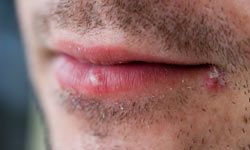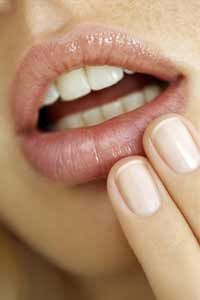
If you've ever had a cold sore, you know the ominous sense of dread of waking up and feeling that slight tingling on your lip, a harbinger of the red, scabbed monstrosity that's about to erupt on your face for all the world to see. Cold sores aren't just unsightly, they're painful and often long-lived, and they can make you self-conscious about your appearances for days or weeks after an outbreak. But you can you act to help minimize your most recent cold sore catastrophe.
First, let's define exactly what a cold sore really is. Many people get confused about whether they have a cold sore or a canker sore. But that confusion is easily cleared up. Cold sores, also called fever blisters, are caused by the herpes simplex virus type 1, which is usually acquired in childhood through contact with infected saliva. The type 1 virus is believed to lie dormant in certain nerve cells of the body until it is activated by stress, anxiety, a cold or excessive exposure to the sun. It causes sores on your external lip or near your mouth or nose that last anywhere from seven to 14 days. (Herpes simplex virus type 2, on the other hand, is transmitted through sexual contact and causes sores and ulcers in the genital area.)
Advertisement
Although many people use the terms "cold sore" and "canker sore" interchangeably, they're different. Unlike cold sores, no one's entirely certain what causes canker sores, which are characterized by small, round, white areas surrounded by a sharp halo of red. And while cold sores are highly contagious, canker sores are not. Researchers suspect that these annoying sores might spring from viral infections, allergies, reactions to medications, certain foods (particularly acidic foods like citrus, or even following trauma causes by a razor-sharp almond shard).
You can't cure cold sores, and they like to keep coming back, usually to the scene of a previous visit. Fortunately, you don't have to suffer in silence with cold sores. In the next pages, we'll look at simple home remedies to ease the discomfort of cold sores and and hasten the healing process.
This information is solely for informational purposes. IT IS NOT INTENDED TO PROVIDE MEDICAL ADVICE. Neither the Editors of Consumer Guide (R), Publications International, Ltd., the author nor publisher take responsibility for any possible consequences from any treatment, procedure, exercise, dietary modification, action or application of medication which results from reading or following the information contained in this information. The publication of this information does not constitute the practice of medicine, and this information does not replace the advice of your physician or other health care provider. Before undertaking any course of treatment, the reader must seek the advice of their physician or other health care provider.