Boomerangs probably came about through a trial and error process. See how the experts think boomerangs were invented.
When most of us think of boomerangs, we imagine somebody (quite possibly a cartoon character) throwing a banana-shaped stick that eventually turns around and comes right back to the thrower's hand (possibly after hitting another cartoon character in the head). This idea is simply amazing, and as children, our first reaction to such a device was: This stick is obviously possessed with magical powers! Of course, the person or people who discovered the boomerang hadn't actually found a magical stick, but they had come upon an amazing application of some complex laws of physics.
Advertisement
In this article, we'll break down the physical principles that make boomerangs work, see what happens as a boomerang flies through the air and find out the proper way to throw a boomerang so that it comes back to you. We'll also delve a little into the history of boomerangs to see how they came about in the first place. Boomeranging is an amazing demonstration of scientific principles as well as a terrific sport you can enjoy all by yourself.
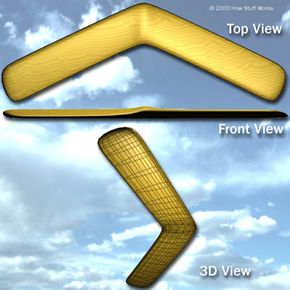
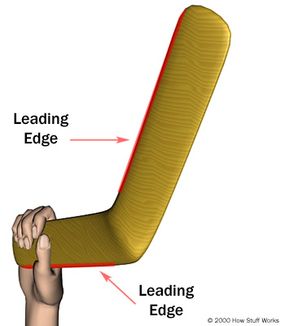
When we talk about boomerangs, we usually mean the curved devices that return to you when you throw them, but there are actually two different kinds of boomerangs. The kind we're all familiar with, returning boomerangs, are specially crafted, lightweight pieces of wood, plastic or other material. Traditionally, these are basically two wings connected together in one banana-shaped unit, but you can find a number of different boomerang designs available these days, some with three or more wings. Most returning boomerangs measure 1 to 2 feet (30 to 60 cm) across, but there are larger and smaller varieties. When thrown correctly, a returning boomerang flies through the air in a circular path and arrives back at its starting point.
Returning boomerangs are not suited for hunting -- they are very hard to aim, and actually hitting a target would stop them from returning to the thrower, pretty much defeating the purpose of the design.
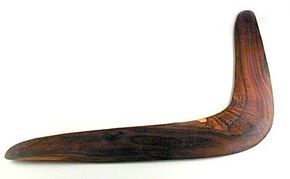
Returning boomerangs evolved out of non-returning boomerangs. These are also curved pieces of wood, but they are usually heavier and longer, typically 3 feet (1 meter) or more across. Non-returning boomerangs do not have the light weight and special wing design that causes returning boomerangs to travel back to the thrower, but their curved shape does cause them to fly easily through the air. Non-returning boomerangs are effective hunting weapons because they are easy to aim and they travel a good distance at a high rate of speed. There is also such a thing as a battle boomerang, which is basically a non-returning boomerang used in hand-to-hand combat.
Advertisement