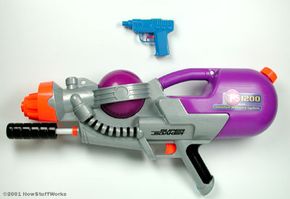
Water guns have come a long way in the past 20 years. An ordinary squirt gun can only shoot water 8 or 9 feet, but a pump-action water blaster, like this Super Soaker CPS 1200, can shoot water more than 50 feet. See more toy pictures.
Soon after its introduction, the water gun took its place among the most popular summer toys of all time, and it's easy to see why: When you're a kid, or a kid at heart, what better way to cool off on a hot afternoon than waging an epic water battle against your friends and family?
Over the years, these toys have evolved considerably. Thirty years ago, a typical water warrior was armed only with a small squirt pistol, which had a fairly short range and an even more limited ammunition reservoir. These days, you'll find an entire arsenal of water weapons at most toy stores, complete with water machine guns, water bazookas and even water grenade launchers.
In this article, we'll find out how these summertime staples produce their drenching blasts. We'll trace the path of water guns from traditional squirt pistols to motorized water Uzis and finally to the pump-action water blasters that dominate the market today.
Before the 1980s, water guns had fairly limited capabilities. Handheld pistols could only shoot water a short distance. They shot a weak, narrow stream and you had to run to a spigot to refill them after every shoot-out. These guns are still terrific toys, of course, and they're a wonderful demonstration of basic plumbing principles.
In a classic squirt gun, there are just a few basic parts:
Advertisement
There is a trigger lever, which activates a small pump.
This pump is attached to a plastic tube that draws water from the bottom of the reservoir (in most cases, the reservoir is the entire inside of the gun).
The pump forces this water down a narrow barrel and out a small hole at the gun's muzzle.
The hole, or nozzle, focuses the flowing water into a concentrated stream.
The only complex element in this design is the water pump, and it's about as simple as they come. The main moving element is a piston, housed inside a cylinder. Inside the cylinder is a small spring. To operate the pump:
You pull the trigger back, pushing the piston into the cylinder.
This compresses the spring, causing it to push the piston back out of the cylinder when you release the trigger.
These two strokes of the piston, into the cylinder and out again, constitute the entire pump cycle.
The downstroke, the piston pushing in, shrinks the volume of the cylinder, forcing water or air out of the pump. The upstroke, the spring pushing the piston back out, expands the cylinder volume, sucking water or air into the pump. In a water gun, you need to suck water in from the reservoir below and force it out through the barrel above. In order to get all the water moving through the barrel, the pump must only force water up -- it cannot force water back into the reservoir. In other words, the water must move through the pump in only one direction.
The device that makes this possible is called a one-way valve. The one-way valve in a basic squirt pistol consists of a tiny rubber ball that rests neatly inside a small seal. There are two one-way valves: one between the reservoir and the pump, and another between the pump and the nozzle.
This pump design is beautiful in its simplicity, but it has a two big limitations:
The amount of water in each blast is limited by the size of the pump cylinder. The size of the pump cylinder, in turn, is determined by the range of the trigger mechanism. To compress and expand more water, you have to push and pull the piston a greater distance, which means pulling the trigger farther back.
The duration of the blast is also limited. Each pull on the trigger creates only a small burst. To squirt water continually, you have to keep squeezing and releasing the trigger.
Throughout the history of water guns, designers have been wrestling with these problems to create a better pumping system. In the next section, we'll look at two simple water-gun designs that increase the stream's range, pressure and duration. Then we'll check out the gun design that blew all other water weapons away.
Advertisement
The Motorized Water Gun
In the last section, we saw that the basic squirt gun uses a simple piston, a cylinder pump and two one-way valves. Since the pump is activated by moving the trigger back and forth, this design is fairly limited in the size, range and duration of its bursts.
One easy solution to this problem is to increase the size of the pump cylinder and the trigger. This is the basic idea behind classic water bazookas like the one shown below. In this design, the trigger mechanism isn't really a trigger at all -- it's more like a syringe. Essentially, you hold the piston in one hand and the cylinder in the other. To suck water in from the reservoir, you pull the piston and cylinder apart. To expel the water, you push them back together.
Advertisement
This gives you much more water to work with in each shot. If you push the piston into the cylinder with great force, you can shoot the water a good distance. If you push it more slowly, you can expand the duration of the blast. Some water bazookas don't have an attached water reservoir: To load them, you must suck in water through the barrel, as you would fill a syringe.
Obviously, this design requires a lot more work from the shooter than the conventional squirt gun, so it's not particularly user-friendly. The 1980s saw the arrival of a new sort of water gun that did almost all the work itself. You can see in the diagram below that these guns work in basically the same way as the conventional squirt gun, except the pump is powered by a small motor rather than by the trigger. The trigger is only a switch that completes an electrical circuit so that the battery can power the motor. The motor moves a series of gears, which move a small cam. The rotating cam has an extended lever that catches the piston, pulls it back and then releases it, allowing a spring to push it forward. In this way, the motor moves the piston in and out of the cylinder, drawing water in from the reservoir on the upstroke and driving it down the barrel in the downstroke.
Since the pump is activated by a turning motor rather than a trigger, the design can have a slightly expanded cylinder size without making it more difficult to shoot. This extends the blast range somewhat. But the real advantage of this design is that the shooter doesn't have to keep pumping the trigger to continually shoot water. If you hold down the trigger, the motor keeps pumping, emitting a rapid series of bursts, like the continual fire of a machine gun.
Both of these gun designs are a substantial step up from the ordinary squirt pistol, but they still have significant limitations. Blasting the bazooka requires a good bit of muscle power from the shooter, and the motorized gun's water stream is still fairly weak. In the next section, we'll look at the water-gun design that revolutionized the industry, building blasts that reach 50 feet (15 m) or more.
Advertisement
The Super Soaker
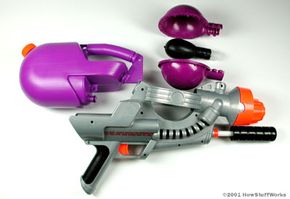
The CPS 1200 Super Soaker has two water reservoirs, an expandable water bladder and a hand-operated pump system.
As we saw in the last two sections, the main problem with conventional water guns is that they don't produce a very powerful stream. This is because the water pressure must be generated with each shot, either by the shooter or by a motorized system. It's not feasible to produce a high-pressure stream because it would mean applying a great deal of force in a short amount of time.
In 1982, a nuclear scientist named Lonnie Johnson came up with an ingenious solution to this problem. In his spare time, he was working on a new heat-pump system that would use moving water to regulate temperature. Late one night, he attached a model of the pumping mechanism to the bathroom sink, and was startled by the powerful water blast that shot across the room. In that instant, he was struck by the idea for a water gun that would use compressed air to provide pressure for a water blast.
Advertisement
To make his idea a reality, Johnson enlisted the help of an accomplished inventor named Bruce D'Andrade. Together, D'Andrade and Johnson came up with the basic design that would become the Super Soaker.
Super Soakers are built around a pump mechanism, but moving the pump doesn't actually drive water out of the gun; it serves to build up water pressure before the blast. In the first wave of Super Soakers, you built up this pressure by pumping air directly into a single water reservoir. As you pumped in more air, it became more and more compressed and so applied greater pressure to the water inside.
In later models, you built pressure by pumping water instead of air.
Unlike its predecessors, this gun has two water reservoirs (labeled A and B), which are connected together via a network of tubes. To load the gun, you fill the larger reservoir (A) with water. To prime the gun for a blast, you pull the pump handle (C) in and out several times. The pump handle is connected to a long, narrow piston (D), which moves back and forth inside a cylinder (E). This pump is similar to the one in a squirt-gun pistol, and it relies on the same one-way-valve system to control the direction of water flow. The first valve (F) is positioned between the large water reservoir and the pump mechanism, and the second valve (G) is positioned between the pump and the smaller water reservoir, which feeds into the barrel of the gun (H).
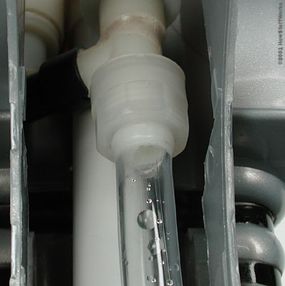
Inside the body of a Super Soaker, you'll find a network of plastic tubes. This is something like the plumbing system that pumps water throughout your house.
On the upstroke of the pump cycle, when you pull the pump handle out, the receding piston pulls in water from the large reservoir above. The second one-way valve (G) keeps water from flowing up from the smaller reservoir (B). On the downstroke of the pump cycle, when you push the pump handle in, the plunging piston drives the water out of the cylinder, through the second one-way valve (G) and into the small reservoir (B). The first one-way valve (F) keeps the pressurized water from flowing back up into the large reservoir (A).
But what is all this accomplishing? In the next section, we'll put the pieces together to see how the Super Soaker builds such a powerful blast.
Advertisement
Super Soaker Parts
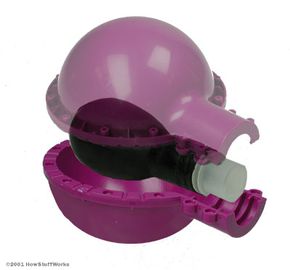
Super Soaker's Constant Pressure System, or CPS, pressurizes water by pumping it into a small, expandable bladder.
The purpose of the pumping system in a Super Soaker is to compress air. Each time you drive water from the large reservoir into the small reservoir, it pushes up against all of the air inside. Air is a compressible fluid -- you can decrease its volume by squeezing it -- but water is not. When you add more and more water to the small reservoir, it takes up a greater and greater volume. Since there is a limited amount of space in the reservoir, these larger volumes of water compress the air inside the gun so that it has a much higher pressure than the air outside the gun. This cushion of high-pressure air pushes on all of the water in the reservoir; the water presses on the sides of the gun, trying to get outside to restore pressure balance.
The only thing keeping the water inside the gun is the trigger mechanism. The trigger is simply a lever secured to the gun housing. A stiff length of metal attached to the housing holds the top part of this lever against the flexible plastic tube leading to the gun's barrel, pinching it so no water can get through. When you pull the trigger back, the metal piece bends, and the lever releases the plastic tube. With this passageway open, the pressurized air can push all of the water out of the gun, reestablishing a pressure equilibrium with the air outside. If you build up enough pressure, the water is expelled at a very high velocity.
Advertisement
Since each bit of water further compresses the air cushion, the force of the blast depends on how much water you pump into the small reservoir. At a high-enough pressure level, the outward force of the compressed air and pressurized water might exceed the structural integrity of the plumbing in the gun, causing it to leak. To prevent this from happening, the trigger mechanism is designed to let some water through when the pressure reaches a certain level. This "leak level" is determined by the strength of the metal that holds the trigger down. Essentially, this piece of metal is like an ordinary spring, and its springiness is determined by its composition. If the metal is more rigid, it will take a higher water-pressure level to push it out of the way. If you have a more flexible piece, the gun will let some water leak at a lower pressure.
In the late 1990s, a new wave of Super Soaker guns came out that boasted higher pressure levels. These guns, developed by Bruce D'Andrade, feature the Constant Pressure System, or CPS. The main component in this system is a simple water bladder. This bladder is like a balloon, but it is made of much more rigid material. These guns have the same sort of pump as other Super Soakers, but the water and air are driven into the water bladder rather than into a plastic reservoir. As you pump more water in, the bladder expands, in the same way a balloon expands as you blow more air into it. When it is stretched, the bladder wants to return to its natural shape, so it applies a good deal of inward pressure on the water. When you pull the trigger and open up the passageway to the gun barrel, this pressure drives all of the water out of the gun. This allows for much more powerful water blasts than can be achieved with compressed air alone.
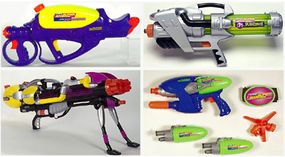
Some of the Super Soakers in the 2001 lineClick on each picture to see a larger image.
Photo courtesy Larami Ltd.
These are just two sorts of pump-based water guns. Lonnie Johnson and Bruce D'Andrade's first Super Soaker and the later addition of the water bladder have launched an entire line of water weapons. For extra ammunition, some designs hook up to a huge water reservoir that you wear like a backpack. Other guns are configured so you can shoot forward, backward and sideways at once. This has altered the world of water guns drastically. In the past, kids knew exactly what to expect when they went to the toy store for a new water gun. These days, the shelves are stocked with a wide range of new designs every summer. Unless you've been to the toy store recently, you have no idea what your neighbors might bring to the next big water fight.
For lots more information on water blasters and related topics, check out the links on the next page.