Modern Space Suit: EMU

EMU Facts
  • Weight = 280 lb (127 kg) on Earth
  • Thickness = 3/16 in (0.48 cm), 13 layers
  • Atmosphere = 4.3 lb/in2 (0.29 atm) of pure oxygen
  • Volume = 4.4 to 5.4 ft3 (.125 to .153 m3) without astronaut
  • Cost = $12 million each
  • Contractors - Hamilton Sundstrand, ILC Dover
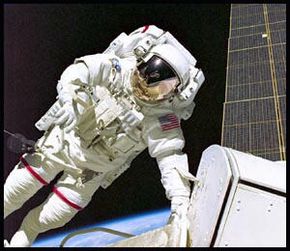
While early space suits were made entirely of soft fabrics, today's Extravehicular Mobility Unit (EMU) has a combination of soft and hard components to provide support, mobility and comfort. The suit itself has 13 layers of material, including an inner cooling garment (two layers), pressure garment (two layers), thermal micrometeoroid garment (eight layers) and outer cover (one layer). The materials used include:
  • Nylon tricot
  • Spandex
  • Urethane-coated Nylon
  • Dacron
  • Neoprene-coated Nylon
  • Mylar
  • Gortex
  • Kevlar (material in bullet-proof vests)
  • Nomex
All of the layers are sewn and cemented together to form the suit. In contrast to early space suits, which were individually tailored for each astronaut, the EMU has component pieces of varying sizes that can be put together to fit any given astronaut.

The EMU consists of the following parts:

  • Maximum Absorption Garment (MAG) - collects urine produced by the astronaut
  • Liquid Cooling and Ventilation Garment (LCVG) - removes excess body heat produced by the astronaut during spacewalks
  • EMU Electrical Harness (EEH) - provides connections for communications and bio-instruments
  • Communications Carrier Assembly (CCA) - contains microphones and earphones for communications
  • Lower Torso Assembly (LTA) - lower half of the EMU including pants, knee and ankle joints, boots and lower waist
  • Hard Upper Torso (HUT) - hard fiberglass shell that supports several structures including the arms, torso, helmet, life-support backpack and control module
  • Arms
  • Gloves - outer and inner gloves
  • Helmet
  • Extravehicular Visor Assembly (EVA) - protects the astronaut from bright sunlight
  • In-suit Drink Bag (IDB) - provides drinking water for the astronaut during the spacewalk
  • Primary Life Support Subsystem (PLSS) - provides oxygen, power, carbon dioxide removal, cooling water, radio equipment and warning system
  • Secondary Oxygen Pack (SOP) - provides emergency oxygen supply
  • Display and Control Module (DCM) - displays and controls to run the PLSS

Diagram of space shuttle EMU showing its components

Maximum Absorption Garment (MAG)
Spacewalking astronauts can spend up to seven hours spacewalking. During that time, their bodies produce urine. Because it takes too much time to pressurize and depressurize both the space suits and the airlocks/spacecraft, astronauts cannot simply go inside the spacecraft and use the toilet to relieve themselves. Therefore, each spacewalking astronaut wears a large, absorbant diaper to collect urine and feces while in the space suit. The astronaut disposes the MAG when the spacewalk is over.

Liquid Cooling and Ventilation Garment (LCVG)
LCVG is a set of Nylon tricot and spandex "long underwear" that is laced with thin plastic tubes. Cool water flows through these tubes to remove the heat produced by the astronaut. The cooling water comes from the space suit's backpack unit or from the spacecraft through an umbilical cord (used in the airlock while preparing for the spacewalk).

astronaut in LCVG
Photo courtesy NASA
Astronaut in LCVG preparing for a spacewalk

EMU Electrical Harness (EEH)
This is a set of communications wires and bioinstruments that is worn by the astronaut inside the suit. It provides connections to the radio and bioinstruments in the suit's backpack. It allows for communication and for monitoring of the astronaut's vital signs (respiration rate, heart rate, temperature, etc.).

Communications Carrier Assembly (CCA)
The CCA is a fabric cap worn by the astronaut. It contains microphones and speakers for use with the radio. It allows hands-free radio communications within the suit.

Lower Torso Assembly (LTA)
The LTA is a one-piece unit that contains the lower half of the EMU, including pants, knee and ankle joints, boots and lower waist. It is fitted to the upper half of the EMU by a metal connect ring. The LTA has loops to tether tools so that they do not float away in space.

Hard Upper Torso (HUT)
The HUT is a hard fiberglass shell in the shape of a vest. It supports several structures including the arms, lower torso, helmet, life-support backpack and control module. It can also hold a mini-tool carrier. Pieces click into the HUT through quick-connect rings.

Arms
Arm units contain shoulder, upper arm and elbow joint bearings so that the astronaut can move his or her arms in many directions. The arm units come in various sizes so that the EMU can be fitted to different astronauts. The arm units fit into the HUT by quick connect rings.

Gloves
Like the arm units, gloves have wrist bearings for easy movement. They fit into the arms by quick-connect rings. The gloves have rubberized fingertips to help astronauts grip things. Astronauts also wear fine-fabric gloves inside the outer glove units for comfort. The outer gloves have loops on them to tether tools.

Helmet
The helmet is made of clear, impact-resistant, polycarbonate plastic, and fits to the HUT by a quick-connect ring. The helmet is padded in the rear for comfort, because the helmet remains fixed rather than rotating with the astronaut's head. It has a purge valve to remove carbon dioxide if the backup oxygen supply must be used. In the helmet, oxygen flows from behind the astronaut's head, over the head and down his or her face. The inside of the helmet is treated with an anti-fog compound prior to the spacewalk.

Extravehicular Visor Assembly (EVA)
The EVA fits over the helmet. It has the following pieces:

  • A metallic-gold-covered visor to filter sunlight
  • A clear, impact resistant cover for thermal and impact protection
  • Adjustable blinders to block sunlight
  • Four head lamps
  • A TV camera

In-suit Drink Bag (IDB)
Astronauts working in a space suit for up to seven hours need water. So the space suit has the IDB, which is a plastic pouch mounted inside the HUT. The IDB can hold 32 ounces (1.9 liters) of water and has a small tube, a straw, that is positioned next to the astronaut's mouth.

There is also a slot in the helmet for a rice-paper-covered fruit and cereal bar that the astronaut can eat if he or she gets hungry during the spacewalk. The bar is designed so that the astronaut can take a bite and pull the remainder up. The entire bar must be eaten at once to prevent crumbs from floating within the helmet. However, most astronauts prefer to eat prior to the spacewalk and not use this bar.

Primary Life-Support Subsystem (PLSS)
The PLSS is the backpack worn by the astronaut. It contains the oxygen tanks (1.2 lb / 0.54 kg at 518 atm tank pressure), carbon dioxide scrubbers/filters, cooling water (10 lb / 4.6 kg total), radio, electrical power, ventilating fans and warning systems. Oxygen flows into the suit behind the astronauts's head and out of the suit at the feet and elbows. Once inside the PLSS, the air flow enters a charcoal cartridge, to remove odors, and then the carbon dioxide scrubber cartridge. The gas flow then goes through a fan, and then to a sublimator that removes water vapor and returns it to the cooling-water supply. The temperature of the air flow is maintained at 55 F (12.8 C). The astronaut can adjust the temperature, pressure and air flow through controls on the DCM. The PLSS provides up to seven hours of oxygen supply and carbon dioxide removal.

The EMU battery is made of 11 zinc cells connected in series. The battery provides about 27 amp-hours of electrical current, and can be recharged inside the shuttle.

Secondary Oxygen Pack (SOP)
The SOP is an emergency oxygen supply that fits below the PLSS on the backpack frame. It has two oxygen tanks that contain a total of 2.6 lb (1.2 kg) at 408 atm tank pressure. This is enough oxygen for 30 minutes, which is sufficient time to get a crewmember back inside the spacecraft. This oxygen supply automatically turns on when the oxygen pressure in the suit drops below 0.23 atm.

Display and Control Module (DCM)
The DCM is a chest-mounted unit. It contains all of the switches, gauges, valves and LCD displays necessary to operate the PLSS. The DCM can be seen by the astronaut, sometimes with the aid of a sleeve-mounted mirror.

In addition to these major parts, the EMU has some of the following accessories:

  • Servicing and Cooling Umbilical (SCU) - provides connections to the spacecraft's oxygen, power, communication and water lines
  • Airlock Adapter Plate (AAP) - holds the EMU pieces while the astronaut is suiting up
  • Helmet Lights and Camera - provide additional lighting and cameras for ground control monitoring
  • Sleeve-mounted Mirrors - help astronauts see gauges on the DCM
  • Sleeve-mounted Checklists - remind them of spacewalk procedures

Servicing and Cooling Umbilical (SCU)
The SCU is an umbilical cord containing tubes for cooling water, electrical wires for power and tubes for oxygen. The SCU is used to provide water, power and oxygen to the EMU while the astronaut is in the airlock preparing for the spacewalk. This helps conserve the EMU's expendable supplies until the astronaut actually leaves the spacecraft.

Airlock Adapter Plate (AAP)
The AAP is a frame mounted to the wall of the airlock that helps hold the EMU pieces while the astronaut is suiting up.

Helmet Lights and Camera
These devices are mounted on the EVA, which fits over the helmet. They are used to help the astronauts and ground controllers see into dark areas.

Sleeve-mounted Mirrors and Checklists
These devices fit over the sleeves of the EMU. The mirrors help the astronauts see the DCM displays and see behind them. The checklists help them remember procedures over the course of a seven-hour spacewalk.

In the next section, we'll find out how an astronaut gets into one of these things.