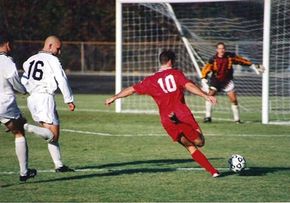
Soccer (or football, if you're not American) is by far the most popular sport in the world. Tens of thousands of fans regularly show up for games played in stadiums on every continent except Antarctica, where they still play but the crowds are rather sparse. For major international matches, worldwide television viewers can number in the hundreds of millions. From its rough and tumble origins to the current crop of multimillionaire celebrity players, "the beautiful game" has thrilled and captivated sports fans for more than 100 years. Learn how to play soccer, where it came from and some tricks to win the game.
Because soccer is a very simple game at its core, many cultures have claimed to have invented it. Games involving teams, balls and some kind of battle over territory have existed in various cultures worldwide since prehistory. Some of them allowed players to carry or throw the ball, while some were brutally violent. The origins of the modern game of soccer can be traced to Britain. There, some holidays were celebrated with mass games played in the streets in which young men from rival villages would strive to steal a ball and carry it to a certain place or goal. These were raucous affairs with hundreds of players, no rules and much damage to the players and village property.
Advertisement
More formal ball games were eventually developed by British schoolboys, but each school had their own set of rules. When different teams played against each other, they had to compromise on the rules used for that particular game. In 1848, representatives from many schools met at Cambridge to try and create a unified rule system, and several more meetings held over the next two decades formed the basis of modern soccer. The football community was divided, however. Some preferred a rougher game in which the ball could be carried, while others were playing something akin to today's soccer. The two sides eventually split, with the other game becoming rugby [Source: Murray]. The soccer clubs formed an organization that would codify and regulate the rules -- the Football Association. Thus, the game became known as Association Football. Today, most of the world simply calls it football, but Americans refer to it as soccer, a term taken from part of the word association.
The game spread from Britain to the rest of the world, with leagues forming in continental Europe, Africa, South America and North America in the latter decades of the 19th century. In 1904, the Fédération Internationale de Football Association (FIFA) was formed to regulate international play. At the time, the major international tournament was the Olympics, but FIFA wanted to create their own world championship. It took until 1930 to happen, and even then only because host country Uruguay agreed to pay travel expenses for every team competing. The hosts beat Argentina 4-2 in Montevideo to win the first World Cup. The tournament has grown steadily in popularity ever since - the 2002 World Cup had an average worldwide television audience of 314.1 million people per game. During a semi-final game between England and Brazil, Brazil's TV Globo had a 94.2 percent market share. That means that virtually every person in Brazil who was watching TV at the time was watching that soccer game [Source: FIFA].
The United States Football Association was formed in 1913. Known today as the U.S. Soccer Federation (or just U.S. Soccer), the governing body for soccer in the United States regulates and promotes soccer from the men's and women's national teams to Major League Soccer, the United States' primary professional soccer league. Development leagues at all levels also receive support from U.S. Soccer. Although the sport does not have a following approaching that of American football, baseball or basketball, soccer in the United States has grown tremendously in the last 20 years. Both national teams have achieved unparalleled success, MLS continues to thrive and youth soccer programs attract millions of young players every year.