Key Takeaways
- Rebreathers allow divers to recycle their exhaled air, removing carbon dioxide and replacing consumed oxygen, enabling no-bubble underwater breathing.
- There are three types of rebreathers: oxygen, semi-closed circuit and closed-circuit, each catering to different diving depths and oxygen toxicity levels.
- Advantages include better gas efficiency, lighter weight due to no need for nitrogen, less decompression time and stealth due to minimal bubble production.
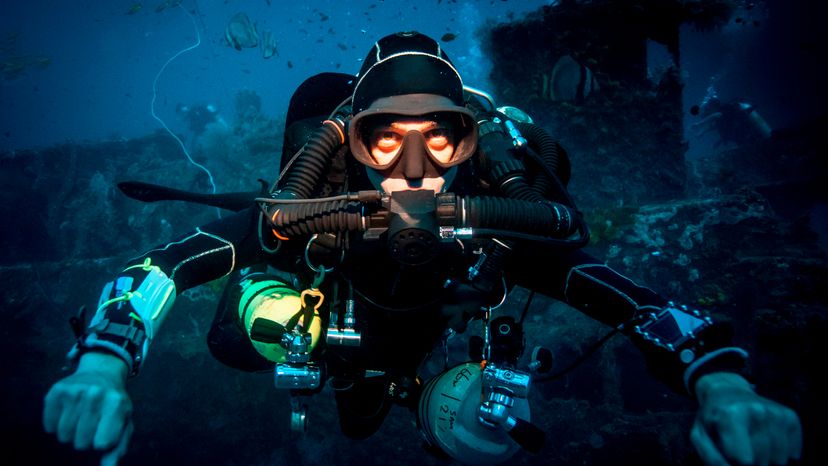
In conventional scuba gear, when you breathe in through the mouthpiece you get a fresh lungful of air from the tank that you carry on your back. When you breathe out, the exhaled air goes out through the regulator into the water in the form of bubbles. A rebreather is a scuba device that allows you to breathe your own air over and over again and produce no bubbles. To allow you to rebreathe your air, the device must do the following:
- Remove your exhaled carbon dioxide. This is accomplished through the use of a cannister of sodium hydroxide (Sofnolime). The carbon dioxide (gas) reacts with sodium hydroxide and calcium hydroxide to form calcium carbonate (solid).
- Replace oxygen that you have consumed. Small tanks of pure oxygen or mixed gases (nitrogen-oxygen or helium-oxygen) inject fresh oxygen into the breathing loop.
- Control the oxygen concentration in the breathing loop. Solid-state oxygen sensors monitor the partial pressure of oxygen in the breathing loop and send this information to a microprocessor that controls the oxygen-delivery system.
You'll find three types of rebreathers: oxygen, semi-closed circuit and closed circuit. Oxygen rebreathers carry a cylinder of pure oxygen as the only gas supply. They're limited to "no decompression" depths and carry a danger of oxygen toxicity. Semi-closed circuit rebreathers use gas mixtures as the gas supply. A diver using a semi-closed rebreather can go to greater depths without risking oxygen toxicity. Closed-circuit rebreathers carry both pure oxygen and mixed gases. They differ from semi-closed circuit rebreathers in the way that they maintain the oxygen concentration.
Advertisement
Rebreathers have several advantages over conventional scuba:
- Better gas efficiency: Conventional scuba wastes oxygen, because divers don't consume all of the oxygen in the air they inhale. rebreathers replace only the consumed oxygen, so the devices don't waste gas.
- Lighter weight: Compressed air is 78 percent nitrogen, so most of the weight of air in conventional scuba is nitrogen. Rebreathers don't have to carry nitrogen along with the oxygen, so for the same amount of oxygen they can be lighter.
- Less decompression: Because the nitrogen in the system, which is involved in "the bends", is kept to a minimum, decompression is less complicated and divers can stay down longer than with conventional scuba.
- Stealth: Rebreathers produce few or no bubbles, so they don't disturb marine life or reveal the diver's presence.
Rebreathers are considered to be advanced scuba gear, originally developed and typically used by the military, especially the U.S. Navy SEALs.
Advanced and commercial divers may use rebreathers, although intensive training is strongly recommended. In addition, the devices are expensive, costing up to $15,000.
Keep reading for more links you might like about breathing or heading underwater.
Advertisement