
Keeping pests from damaging crops challenges even the best farmers. The invention of chemical pesticides has made that task easier but introduced a new hurdle to overcome – finding something that keeps bugs away without damaging the health of unintended victims.
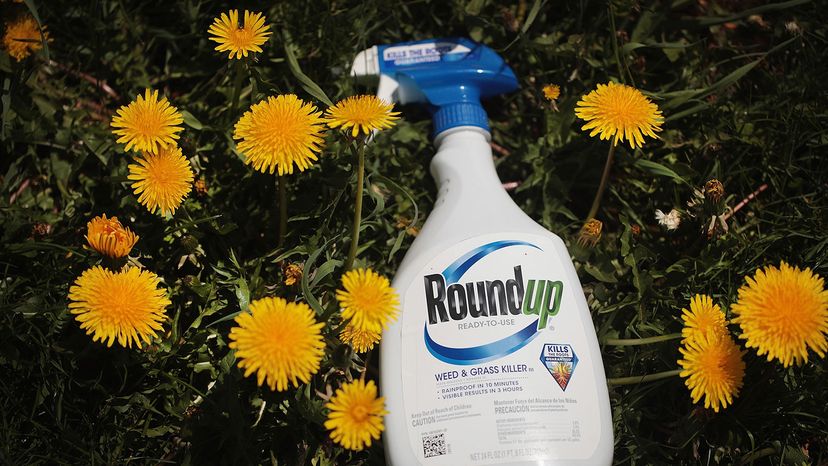
Roundup (a trade name used by Monsanto) and other herbicides based on glyphosate (its generic name) are some of the most commonly applied weed killers in use today in the U.S. These herbicides are used by everyone from farmers to foresters to gardeners to biologists trying to control invasive exotic plants.
Advertisement
Glyphosate-based herbicides all work on the same biochemical principle – they inhibit a specific enzyme called EPSP synthase [source: Funke et. al.]. Without that enzyme, plants are unable to produce other proteins essential to growth, so they yellow and die over the course of several days or weeks. A majority of plants use this same enzyme, so almost all plants succumb to glyphosate.
If all plants need EPSP synthase to live, why do farmers use glyphosate at all? As use of the herbicide has become popular, scientists developed genetically modified versions of plants that could tolerate the chemical. In fact, as of 2018, 91 percent of the cotton, 94 percent of the soybeans and 90 percent of the corn grown in the United States were so-called "Roundup-Ready" varieties [source: USDA]. The idea was simple: the chemical kills the bad plants and leaves the good plants.
In recent years, many people have become concerned about eating genetically modified foods. When you add the glyphosate in, you find even more are concerned about the safety of the herbicide and the crops designed to tolerate it.
Although generally believed to be less toxic to humans than other herbicides, some experts have concerns about the possibility that it may disrupt endocrine activity in people [source: U.S. National Institutes of Health]. Other animals, including frogs and fish, may also suffer negative effects.
Scientists continuing to study glyphosate have noted increases in Non-Hodgkin lymphoma, a type of cancer, in some people exposed to the chemical [source: Dixon]. The World Health Organization's International Agency for Research on Cancer stated in March 2015 that it believed glyphosate is "probably carcinogenic to humans."
However, the news agency Reuters discovered evidence that the IARC's report had edited out some scientists' conclusions that glyphosate was not linked to cancer in lab animals. In August 2019, the U.S. Environmental Protection Agency (EPA) said it wouldn't approve cancer warning labels for glyphosate.
The EPA says that based on its review of long-term animal studies there is no evidence that glyphosate is toxic to the nervous or immune systems, nor is it a developmental or reproductive toxin. However, the agency noted that glyphosate is usually combined with other ingredients when sprayed and that it may cause skin and eye irritation [source: National Pesticide Information Center]. Others say it is quite toxic to animals and humans.
However, glyphosate-resistant "superweeds" have been "cropping up" (pardon the pun) thanks to farmers' overreliance on the herbicide. The solutions to this dilemma include using a variety of pesticides on farmland (rather than just one) and further engineering seeds so that they include traits that make them resistant to different herbicides [source: Genetic Literacy Project, Wilkerson]. Both of these methods have their critics. More environmentally friendly solutions include using cover crops, rotating crops and pulling weeds out manually, all of which are labor-intensive.
Advertisement