Introduction to How A Newspaper Works

© iStockphoto.com/Katie Molin
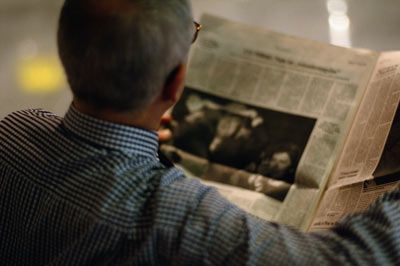
The newspaper has played an important role in keeping the public informed on current events.
Newspapers are the original form of broadband communication, a distinction not always recognized in the age of the Internet. Long before we had computers, television, radio, telephones and telegraph, newspapers were the cheapest and most efficient way to reach mass audiences with news, commentary and advertising. Newspapers, from their beginnings as hand-printed "broadsheets", have been a true random-access medium -- readers can move easily and quickly through the different sections of a newspaper, returning to them days or even weeks later. And because a newspaper's "software" consists of a common language, it possesses a universal and timeless quality. For example, a newspaper published before the American Revolution is as readable today as it was in 1775!
Up Next |
In this edition of How Stuff Works, we'll take a behind-the-scenes look at the increasingly complex business of running a newspaper, using The Herald-Sun of Durham, N.C. as a real-world example. We'll examine how the news is covered and reported, how it makes it into the newspaper and how the newspaper makes it to the press and then to your neighborhood and racks across the circulation area. We'll also look at the newspaper as a business and discuss how it balances making money with serving an important communications role in our society.
While that newspaper from 1775 is still readable, there is one great disparity between a newspaper of 1775 and its modern counterpart. The 1775 newspaper was published under the whim of a British colonial government with little tolerance for the free expression of ideas -- particularly radical political ideas. The First Amendment, part of the Bill of Rights added to the American Constitution in 1791, forbids laws abridging freedom of the press. In an era of kings and emperors, this was a heretical unleashing of individual freedom and a frightening challenge to state authority. It remains so in many nations today.
The principles and practices that govern today's newspapers -- journalistic objectivity, concise writing, national and international news -- emerged after the American Civil War. This was the Golden Era of daily newspapers, golden not only in their enormous number and diversity, but also in the profits that allowed press barons like William Randolph Hearst and Joseph Pulitzer to live on a regal scale. Never before or since have newspapers wielded so much influence on American politics and culture. Hearst, part of whose newspaper empire survives today, was so powerful that he is credited (or blamed) for the outbreak of war with Spain in 1898.
Newspaper Growth
With the growth of television news in the 1960s, newspapers confronted their first formidable competitor. Today, ABC News claims that more Americans get their news from ABC than from any other source -- and it's probably true. The United States' 1,600 daily newspapers continue to serve millions of readers, but newspapers are no longer the country's dominant mass medium. How to survive and even flourish in a culture more attuned to electronic media than to printer's ink is the most serious issue facing the newspaper industry as it enters the 21st century.
It is safe to say that newspapers are not about to follow the Morse telegraph into oblivion. Newspapers are a portable, convenient medium. No one lugs a computer monitor to the breakfast table to get the morning news. And, newspapers are proving surprisingly adept at reinventing themselves for today's readers by emphasizing good design, color photography and detailed stories that report and interpret current events. As a Manhattan reader might say of the venerable New York Times, there's a lot of life left in the "Old Gray Lady."
If you take the time to see how a newspaper reproduces itself every 24 hours, you will find it fascinating! Many different individuals and departments contribute to a process that resembles a river with numerous tributaries. Among these streams are five with daily importance to a newspaper's readers -- news, editorial, advertising, production and distribution. Let's look at how these streams merge into a Niagara of words and images flowing through a computer network and onto huge rolls of paper racing through thunderous presses, all while most of us are sleeping.
What Exactly Is News and How Does It Work?

Photo by Bernard Thomas
Reporters hard at work in the newsroom at The Herald-Sun
Curiously, for a publication called a newspaper, no one has ever coined a standard definition of news. But for the most part, news usually falls under one broad classification -- the abnormal. It is human folly, mechanical failures and natural disasters that often "make the news."
Reporters are a newspaper's front-line eyes and ears. Reporters glean information from many sources, some public, such as police records, and others private, such as a government informant. Occasionally, a reporter will go to jail rather than reveal the name of a confidential source for a news story. American newspapers proudly consider themselves the fourth branch of government -- the watchdog branch -- that exposes legislative, executive and judicial misbehavior.
Some reporters are assigned to beats, or an area of coverage, such as the courts, city hall, education, business, medicine and so forth. Others are called general assignment reporters, which means they are on call for a variety of stories such as accidents, civic events and human-interest stories. Depending on a newspaper's needs during the daily news cycle, seasoned reporters easily shift between beat and general-assignment work. (New reporters once were called cubs, but the term is no longer used.)
In the movies, reporters have exciting, frenzied and dangerous jobs as they live a famous pronouncement of the newspaper business: "Comfort the afflicted and afflict the comfortable." Although a few members of the media have been killed as a result of investigations into wrongdoing, newspaper work for the great majority of reporters is routine. They are our chroniclers of daily life, sorting, sifting and bringing a sense of order to a disorderly world.
All reporters are ultimately responsible to an editor. Depending on its size, a newspaper may have numerous editors, beginning with an executive editor responsible for the news division. Immediately below the executive editor is the managing editor, the person who oversees the day-to-day work of the news division. Other editors -- sports, photo, state, national, features and obituary, for example -- may also report to the managing editor.
However, the best known and in some ways the most crucial editor is the city or metro editor. This is the editor that reporters work for directly. The city or metro editor assigns stories, enforces deadlines and is the first to see reporters' raw copy on the composition system or computer network. These editors are called gatekeepers, because they control much of what will and will not appear in the next day's paper. Often working under the stress of breaking news, their decisions translate directly into the content of the newspaper.
Once the city or metro editor has finished editing a reporter's raw copy, the story moves from the composition system via the computer network to another part of the news division, the copy desk. Here, copy editors check for spelling and other errors of usage. They may also look for "holes" in the story that would confuse readers or leave their questions unanswered. If necessary, copy editors may check facts in the newspaper's library, which maintains a large collection of reference books, microfilm and online copies of stories that have appeared in the paper.
The copy desk chief routes finished stories to other editors who fit local and wire service stories, headlines (written by the editor -- not the reporter!) and digital photographs onto pages. Newspapers are increasingly doing this work, called pagination, with personal computers using software available at any office supply store. Microsoft Windows, Word and Quark Express are three programs that, though not designed for newspaper production, are easily adapted for it. Before we see what happens to the electronic pages built by the copy desk, it will be helpful to understand how other divisions of the newspapers contribute to the production cycle.
Editorial Pages
A newspaper publishes its views on current events -- both local and national -- on its editorial pages. This is where editorials, unsigned commentary that reflects the collective position of the newspaper's editorial board, appear. Editorials are not news, but rather reasoned opinion based on facts. For example, editorials may criticize the performance of public officials such as the mayor, the police chief, or the local school board; conversely, editorials may praise others for their civic contributions. Whatever the topic, newspapers hope their editorials will raise the level of community discourse.
Two ways this occurs are familiar to any newspaper reader -- letters to the editor and op-ed articles. Letters are always among the best-read section of any newspaper, for this is where readers express their opinions. Some newspapers limit letters to a certain number of words -- 150, 250 or even 300 -- while others publish letters of virtually any length. Op-ed articles (a contraction of opposite-editorial page) usually run 850 to 1,000 words. Newspapers make space for letters to the editor and op-ed articles freely available as part of their contribution to civic dialogue.
The editorial pages are under the direction of an editor outside the news division. Newspaper people call this "separation of church and state," meaning there is a line between news and opinion that must not be crossed. To do so strips a newspaper of its most valuable asset -- credibility. For that reason, editorial page editors at some large newspapers report to the publisher, who is the chief executive officer of the company, and not to the executive editor. Other newspapers may have their editorial page editor reporting to the executive editor. Whatever the organizational model, though, neither department can tell the other what to publish in the newspaper.
The number of pages beyond a minimum that most newspapers set is is determined not by the news division, but by the amount of advertising sold for that day. (Regardless of advertising, however, newspapers add extra news pages for big local stories such as tornadoes, sports championships or other major events.) The advertising division places ads on pages before they are released to the news division. As a rule, newspapers print slightly more advertising than news. Ads may account for 60 percent or more of weekday pages, but in the larger Sunday edition, it is not unusual for news to take up more space than ads. The ratio of ads to news must be high because newspapers cannot stay in business without advertising revenue. Editors call the space left for them a "news hole." The advertising division and the news division have no influence over each other's content.
Three types of advertising dominate modern newspapers:
- Display ads -- With photos and graphics, display ads can cost thousands of dollars depending on their size. These ads, generally placed by department stores, movie theaters and other businesses, may be prepared by an advertising agency or the advertising department itself. They are called run-of-press ads and they produce the most revenue.
- Classified ads -- Classified ads, often called want ads, appear in a miniature typeface called agate. These ads come from individuals trying to buy or sell items, businesses seeking workers, or tradespeople offering a wide variety of services. "Classies" are affordable, popular and highly effective in reaching tens of thousands of potential customers.
- Inserts -- Inserts, the third form of advertising, are favored by large national chain stores like Best Buy and Circuit City. These colorful booklets are trucked to newspapers in huge bundles for distribution with the Sunday edition. Inserts produce less revenue than run-of-press advertising. Newspapers charge for distributing inserts, but otherwise have no control over their content or print quality.
Newspaper Production

Photo courtesy of The Herald-Sun
Modern presses are huge and noisy but expensive and essential to the success of a newspaper.
The production division does the heavy lifting of newspaper work. Within this division's departments are specialists who run and maintain the presses, typesetters, image scanners and photographic engraving machines. Some workers are assigned to the day shift, others to the night shift.
Beginning around1970, newspaper production divisions began a historic shift away from the labor-intensive technology of Linotype typesetters and other "hot type" machines used in relief printing. This was the same technique used by Johannes Gutenberg in the 14th century: pressing a page of paper directly onto a block of type. The invention of "cold type" based on photographic processes sped production and cut the high overhead costs of relief printing. Also, cold type worked better with new offset printing presses coming into use.
Most daily newspapers have moved to some form of offset printing. This process etches the image of a newspaper page onto thin aluminum plates. (Pages with color photos or type require extra plates.) These plates, now bearing a positive image developed from a full-page photographic negative, then go to other specialists for mounting on the press. The process is called offset because the metal plates do not touch the paper going through the press. Instead, the plates transfer their inked image to a rubber roller, which in turn prints the page.
Although newspaper presses are big and noisy, they are remarkably gentle on newsprint, the paper in newspaper. The presses have to be gentle -- expensive newsprint streaming off huge rolls must wind through a press without tearing. These complex machines, which can cost $40 million or more and stand three stories tall, are called web presses because they use streaming paper instead of individual sheets.
In addition to putting ink on paper, the press also assembles the pages of a newspaper in correct sequence. All this occurs so quickly that a modern offset press can spew 70,000 copies an hour onto conveyor belts that speed the copies to the waiting distribution division.
Newspaper Distribution

Photo courtesy of the The Herald-Sun
Newspaper distributors pick up their bundles at The Herald-Sun in the early hours of the morning.
Responsibility for getting the newspaper from the press to the reader falls to the distribution division. Large newspapers publish two, three or even four editions, all of which must be ready to leave the newspaper plant at a certain time. The first edition, sometimes called the bulldog edition, goes to the outer limits of the newspaper's circulation area. This may be several counties or even an entire state. Later editions contain progressively fresher news and go to smaller areas. The final edition, which goes to press after midnight, contains the latest news but covers the smallest geographical area, usually a city.
Any subscriber to a daily newspaper knows that it plops onto the driveway in the wee hours of the morning. Independent contractors called carriers buy copies of the newspaper at a discount and deliver them, using their personal vehicles. When afternoon newspapers were common, those vehicles often were bicycles. The first job for many American youngsters was delivering the afternoon paper in their neighborhood.
The circulation department draws the routes that carriers follow. This department is also responsible for rack sales, newspapers that go into coin-operated dispensers. The circulation department maintains subscribers' billing records, stops and starts deliveries upon request, and uses service runners to deliver missing papers.
Because a newspaper's circulation, the number of people who receive the paper, has a substantial impact on its advertising rates, an independent agency called the Audit Bureau of Circulations examines and certifies circulation numbers. This assures both the advertising division and advertisers that circulation claims are valid.
In 18 hours of highly coordinated work carried out by numerous divisions, what newpaper people call a "rough draft of history" has moved through computer systems, imaging machines and presses that would amaze Gutenberg, to its final destination -- the readers. After 3:30 a.m., few people remain at a newspaper plant. All the other divisions have gone home. The presses have fallen silent, perhaps undergoing maintenance for the remainder of the night. The sudden silence will not last long. In less than four hours, the newspaper, as it must do 365 days a year, will rouse from its short sleep and start all over again.
Lots More Information
Related HowStuffWorks Articles
- 10 Unsuccessful Senate Confirmations
- How Political Conventions Work
- How Protests Work
- How Presidential Pardons Work
More Great Links
- The Herald-Sun (Durham, N.C.)
- History of Newspapers
- The First Amendment Project
- History of the Printing Press
- American Printing History Association