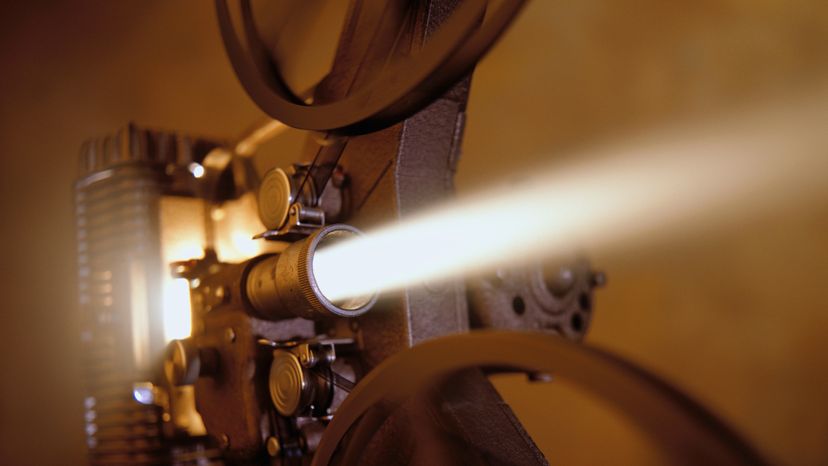
Projectors are vital instruments in showing movies in theaters Lawrence Manning / Getty Images
Movies are part of every modern culture. And while movies on VHS and DVD are extremely popular, nothing replaces the larger-than-life spectacle of a grandiose film, such as "The Patriot," filling the big screen. In the United States alone, there are more than 37,000 movie screens, a clear testament to just how much we love to go to the movies!
To show a modern film-based movie, there are five things you absolutely need:
A way to advance each frame of the film
A way to project the image from the film
A way to read the audio
A surface to project the image on
A system to play the audio
A projector provides the first three items on our list. While movies are usually projected onto a screen, a large white wall is all you really need.
Thanks
Special thanks to Bill Peebles, owner of the Lumina, Rialto, Colony and Studio theaters, for the projector and theater photos and his valuable assistance; Crawford Harris, owner of Reel Automation, for his assistance and advice; and the North Carolina School of Science and Mathematics for the optical toy photos in the Wileman Collection.
A movie projector is a device that continuously moves film along a path so that each frame of the film is stopped for a fraction of a second in front of a light source. The light source provides extremely bright illumination that casts the image on the film through a lens onto a screen.
There are four major groups of parts that make up a projector:
Audio assembly (optical and digital readers, infrared LED)
In the following sections, we'll look at the first three assemblies. For information on the audio assembly, check out How Movie Sound Works.
Advertisement
Spooling the Film
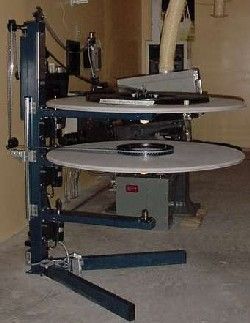
The platter sits besidethe projector.
It takes an amazing amount of film to make a movie. Most movies are shot on 35mm film stock. You can get 16 frames (individual pictures) on 1 foot (30.5 cm) of film. Movie projectors move the film at a speed of 24 frames per second, so it takes 1.5 feet (45.7 cm) of film to create every single second of a movie.
At this rate, you end up needing a lot of film pretty quickly. Consider these calculations:
Advertisement
One second = 1.5 feet (24 frames per second divided by 16 frames per foot)
One minute = 90 feet (1.5 feet per second multiplied by 60 seconds)
One hour = 5,400 feet (90 feet per minute multiplied by 60 minutes)
Typical two-hour movie plus five minutes of previews = 2.13 miles (11,250 feet divided by 5,280)
You can use this formula to figure out just how much film it took to show the next movie you go see. Just multiply the number of minutes in the movie by 90 to get the number of feet of film.
Because a feature length film is so long, distributors divide it into segments that are rolled onto reels. A typical two-hour movie will probably be divided into five or six reels. In the early days, films were shown with two projectors. One projector was threaded with the first reel and the other projector with the second reel of the movie. The projectionist would start the film on the first projector, and when it was 11 seconds from the end of the reel, a small circle flashed briefly in the corner of the screen. This alerted the projectionist to get ready to change to the other projector. Another small circle flashed when one second was left and the projectionist pressed a changeover pedal to start the second projector and stop the first one. While the second reel was rolling, the projectionist removed the first reel on the other projector and threaded the third reel. This swapping continued throughout the movie.
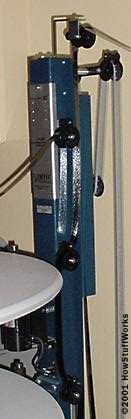
In the 1960s, a device called a platter began to show up in theaters. The platter consists of two to four large discs, about 4 or 5 feet in diameter, stacked vertically 1 to 2 feet apart. A payout assembly on one side of the platter feeds film from one disc to the projector and takes the film back from the projector to spool onto a second disc. The discs are large enough to hold one large spool of the entire film, which the projectionist assembles by splicing together all of the lengths of film from the different reels. Splicing is the process of cutting the end of one strip of film so that it carefully matches up to the beginning of the next strip of film, and then taping the strips together.
Once projectionists could put all of the film for a movie on a single spool, a couple of things happened:
One projector could show the entire film.
One projectionist could easily run movies in several auditoriums at the same time.
These two factors made it less expensive to show movies because you needed less manpower and fewer projectors. This led to the birth of the multiplex, a group of several auditoriums in one theater. Since their introduction, multiplexes have grown from two or four auditoriums to 15 to 20. These super-sized theaters are often referred to as megaplexes.
Advertisement
Moving the Film
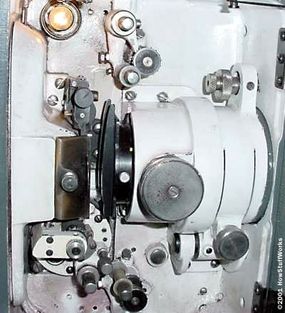
Once a projectionist splices the film and loads it on the feed platter, he threads the film through the platter's payout assembly and into the top of the projector. A strip of film has small square holes along each side called sprocket holes. These holes fit over the teeth of special gear-like wheels called sprockets. The sprockets, driven by an electric motor, pull the film through the projector. Cambers, small spring-loaded rollers, provide tension to keep the film from bunching up or slipping off the sprockets.
The film needs to advance one frame, pause for a fraction of a second and then advance to the next frame. This is accomplished using one of two mechanisms. The first one uses a small lever known as the claw, which is mounted on a bar next to the film's path. The claw is connected to the outer edge of a wheel that acts as the crank. The circular motion of the crank makes the claw lift up and out to come out of a sprocket hole and then down and in to catch onto another sprocket hole. This causes the film to advance one frame. The speed of the sprockets is closely synchronized with the lever action of the claw to make sure that the claw is consistently advancing the film at a rate of 24 frames per second.
Advertisement
The second type uses another sprocket wheel mounted just below the aperture gate. This intermittent sprocket rotates just far enough to pull the film down one frame, pauses and then rotates again. Intermittent sprockets provide more reliable performance and do not wear out the sprocket holes as quickly as the claw.
The film is stretched over a couple of bars as it passes in front of the lens. The bars serve to keep the film tight and properly aligned. Depending on the projector's configuration and the sound format used, the film will pass through an optical audio decoder mounted before or after the lens assembly. For digital sound, the film will travel through a special digital decoder attached to the top of the projector. As the film leaves the projector (or the digital-audio decoder), it is carried on a series of rollers back to the platter's payout assembly and spooled to a take-up platter.
Advertisement
Projecting the Film
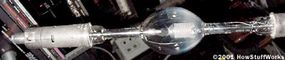
The key element in a projector is the light source. Carbon arc lamps have been used since the early 1900s but have a very short life. Xenon bulbs are the most commonly used lamps today. Xenon is a rare gas with certain properties that make it especially suited for use in projectors:
In dense enough quantities, it will conduct electricity.
As a conductor, it glows very brightly.
It will continue to provide bright illumination for a substantial amount of time (2,000 to 6,000 hours).
Constructing a xenon bulb is a tricky process. The bulbs have a quartz envelope instead of a glass one because the bulbs get very hot. The quartz shell houses a cathode and an anode. Since the xenon gas itself is conductive, the bulb doesn't need a filament. Instead, when a current is applied to the bulb, the charge arcs between the cathode and anode. For the bulb to shine brightly enough, the xenon must be pure and the quartz envelope must be vacuum sealed. Because of the rarity of xenon and the complicated processes involved in bulb production, xenon bulbs generally cost $700 or more each.
Advertisement
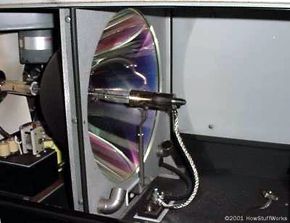
The xenon bulb is mounted in the center of a parabolic mirror located in the lamphouse. The mirror reflects light from the bulb and focuses it on the condenser. The condenser is a pair of lenses used together to further intensify the light and focus it on the main lens assembly. The heat generated by this focused light is incredible. That's why film melts so quickly when the projector stops spooling it.
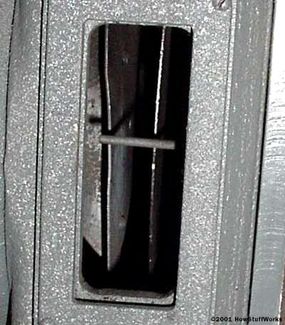
As the focused light leaves the lamphouse and enters the projector, it is intercepted by the shutter. The shutter is a small, propeller-like device that rotates 24 times per second. Each blade of the shutter blocks the path of the light as it comes to a certain point in its revolution. This blacking out is synchronized with the advancement of the film so that the light doesn't project the fraction of a second when the film is moving from one frame to the next. Without it, the film would seem to flicker or have faint impressions of the images out of sync. Many projectors use double shutters that rotate in opposite directions. This causes the light to be cut off from both the top and bottom of each frame, further reducing the possibility of flicker.
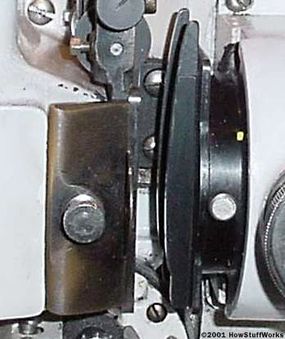
Before the light gets to the film, it also passes through an aperture gate. The aperture gate is a small, removable metal frame that blocks the light from illuminating anything but the part of the film that you want to see on the screen. Two good examples of unwanted images would be the sprocket holes and audio information along the sides of the film. Aperture gates come in a variety of sizes that correspond to the screen format of the movie.
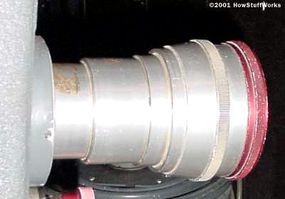
From the aperture gate, the light passes through the film and into the main lens. The lens is removable and can be changed depending on the format of the film. The two most common lenses are flat and CinemaScope. Many projectors have a turret that allows both types of lenses to be mounted, and the projector will rotate the required lens into place.
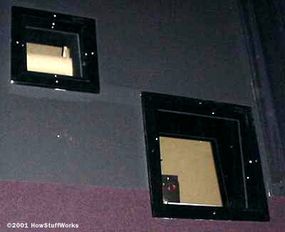
From the projector, the light goes through a viewport at the front of the projection booth and travels to the front of the auditorium until it reaches the screen. Finally, the images from the film appear on the screen.
Advertisement
Automating the Process
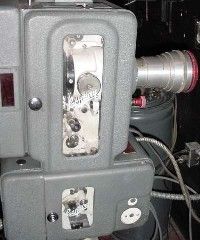
Tens of thousands of movie theaters across the U.S. use projectors like this one.
Projectionists have developed many innovative techniques to ensure that the show proceeds as it should. Cue tape is one of the more interesting and useful of these. It is a short strip of metal fastened to the edge of the film at a specific location. At the appropriate time, the film passes two electrical contacts, and the cue tape completes a circuit between the contacts. This circuit acts like a switch, and it can serve a variety of functions. A cue-tape switch can:
dim the house lights
turn off the house lights
change the lens setting
change the sound format
change the screen masking (masking is the use of curtains to frame the screen)
switch projectors
The last item on the list is not very relevant since most theaters now use platters, but changing projectors is the original reason that cue tape was invented. With cue-tape switches, manufacturers were able to automate the process of beginning one reel as the other ended. Enterprising projectionists soon realized that they could automate a number of other functions as well by using certain combinations of cue tape to trigger specific responses.
Advertisement
Cue tape has made it possible to automate many aspects of movie projection, such as changing sound formats between the previews and the movie, but new systems like Reel Automation's Showtimer promise to greatly enhance and expand automated processes.
Advertisement
History
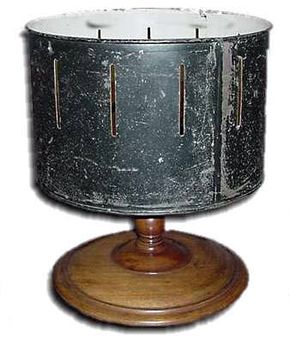
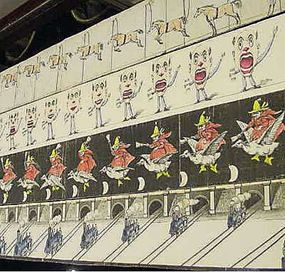
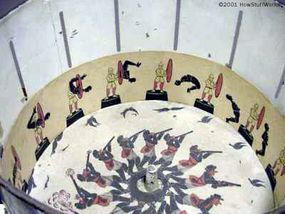
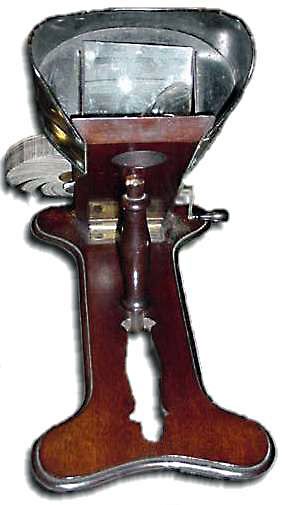
Movies, short for moving pictures, have been around for more than a century. Movies work because of persistence of vision, the fact that a human eye retains an image for about one-twentieth of a second after seeing it. In the early 19th century, several devices began to appear that used persistence of vision to create the illusion of motion from still images. The zoetrope, invented by William George Horner in 1834, consisted of a series of pictures on a paper strip arranged on the inside of a revolving drum. The drum had small slits you could look through to see the pictures.
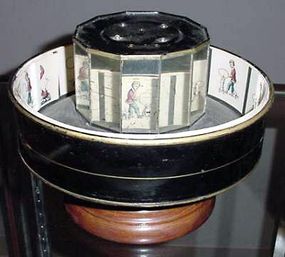
In the case of a particular sort of zoetrope called the praxinoscope, there was a mirrored drum in the middle, so that you could see the pictures by looking through the top of the device. The pictures on the drum changed slightly from one to the next. By spinning the drum, you could make the pictures move fast enough to fool your eye into thinking it was looking at one moving picture. These pictures were typically of some repetitious movement, such as a person walking or dancing, because this movement could be looped easily. In a looped strip of images, the last picture in the series would almost match up to the first one, so that the images would create a single cycle of the simulated movement, which could be infinitely repeated to produce the illusion of continuing movement.
Advertisement
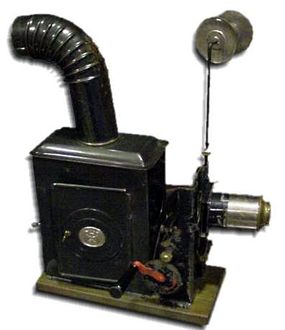
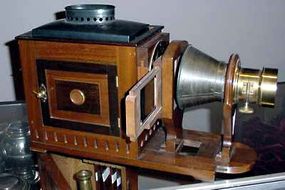
The earliest film projectors, such as the magic lantern, actually showed up in the late 1600s, but they presented only still images. Some of the earliest projectors to show moving images were simply modified zoetropes. Creative entrepreneurs used translucent strips on the drum and placed a light source, usually a lantern, in the middle of the box. They would then project the image through a small hole, or aperture, onto a blank wall or piece of stretched white cloth. Obviously, these devices were very limited. They were operated by hand and were used the same type of looping animation or photos as the original zoetrope.
Pictures line the inside of the drum of a zoetrope.
Everything changed with the invention of Thomas Edison's kinetoscope in 1891. The kinetoscope used a motor to revolve a strip of film in front of a light source. The light source projected the image from the film on a screen in a booth. As it became obvious that people were willing to pay money for this type of entertainment, many inventors began to design variations of Edison's original device. One such variation, the manually operated kinora, was invented by the Lumiere brothers and enjoyed great success into the 1930s.
The Lumiere brothers, Louis and Auguste, created the astounding cinematographe in 1895. This portable device was a camera, film processing lab and projector all in one package! The brothers traveled the French countryside shooting films that lasted a few minutes at most. They then processed and projected the film on location! The next year, the vitascope (which was another variation of the kinetoscope) heralded the dawn of a new age of entertainment. The vitascope worked like a basic kinetoscope with one essential difference: The image was projected onto a large screen in a room instead of a small one in a booth. Thus began the road to the development of the first theater, the Nickelodeon in Pittsburgh, PA.
Throughout the 20th century, movies and projectors grew in complexity. Engineers outfitted projectors with sprockets and spools to make it easier to move the film rapidly in front of the light source. Movies went from a few minutes in length to an hour or more, and by the late 1920s, movie-goers were enjoying "talkies," films that included a soundtrack. The first color movies appeared in the 1930s, and the 1940s and 1950s saw the development of several new processes and screen formats. The platter, which revolutionized the industry, debuted in the 1960s. Automation began to take hold in the 1970s and 1980s, and the 1990s saw the advent of digital sound and the growth of LCD technology. Still, although modern projectors are brighter, faster and more functional than their predecessors, and manufacturers have added many bells and whistles over the years, the essence of the projector has remained the same since the beginning of the 20th century.
Although digital projectors are now springing up in select theaters, the movie-theater industry is still overwhelmingly analog. This is simply a matter of practical consideration. Most theaters have spare parts and local technicians who can service an analog projector easily. Repairing a digital projector, on the other hand, often requires flying in a specialized technician in addition to buying replacement parts. Digital projectors use LCDs to create the image instead of film. At first, this sounds great -- no more scratches or spots! But LCD projectors do have a major drawback: If the LCD has a bad pixel or two (which happens quite often), that blemish will appear throughout every movie shown on that projector. With film, once you replace the scratched film or go to another movie, you lose all the picture blemishes.
For more information on movie projectors and related topics, check out the links on the next page!