
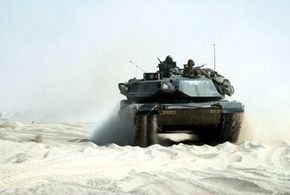
Photo courtesy U.S. Department of Defense
General Dynamics delivered the first M1 Abrams battle tanks to the U.S. Army in 1980, but it wasn't until 1991's Operation Desert Storm that the world fully appreciated the weapon's capabilities. The U.S. Army and Marine Corps deployed nearly 2,000 M1s to the Persian Gulf, and all but 18 returned in working condition. The tanks sped over the rough desert terrain, through heavy smoke from oil fires, destroying almost all of the Iraqis' Soviet tank fleet. In the entire operation, the United States didn't lose a single M1 crew.
The M1 is the world's preeminent tank because it combines four crucial qualities:
Advertisement
- Superior mobility - to get to targets and escape attack
- Superior sensors and controls - to locate and hit targets
- Superior firepower - to destroy targets
- Superior armor - to withstand attack
In this article, we'll examine these major components to find out how the M1 completes its mission.