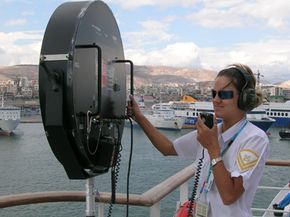
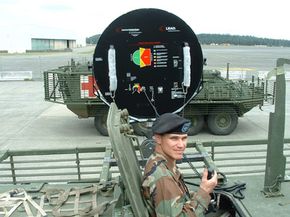
The LRAD's job is to make sound — lots of sound. It produces a very loud sound that's audible over relatively long distances. But it's not limited to producing painful noise for use as a sonic weapon. It can also amplify voices or recordings to a level that's loud and clear but not painful or debilitating.
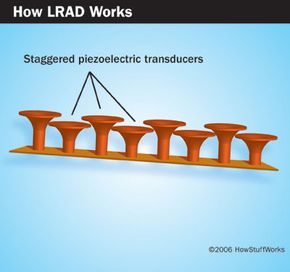
Instead of using one big, moving device to make all this sound, the LRAD uses lots of little ones. A speaker usually uses one rapidly moving diaphragm to make sound. The LRAD uses an array of piezoelectric transducers. A transducer is simply a device that changes one kind of energy into another kind of energy. In this case, it changes electrical impulses into sound.
A piezoelectric material is a substance that's electrically polarized permanently — it has a positively charged side and a negatively charged side. If you apply pressure to a piezoelectric material, it creates an electrical impulse. On the other hand, if you apply an electrical charge to it, its molecules move and it changes shape.
Using electrical current from a battery, generator or other source, the LRAD applies electrical charge to lots of piezoelectric transducers. The transducers rapidly change their shape and create sound waves. Applying a charge to a piezoelectric material causes it to change shape.
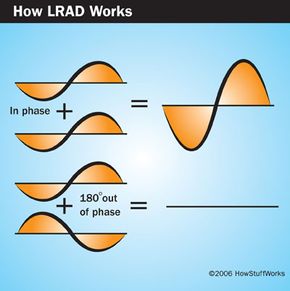
All of these transducers are attached to a mounting surface. They're staggered to allow more of them to fit into a smaller space. This helps the LRAD create very loud sounds — identical waves emerge from the transducers, and their amplitudes combine to create louder sounds.