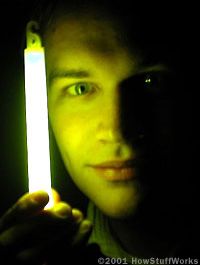
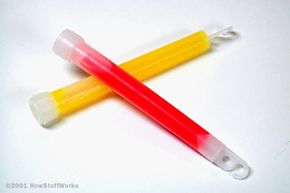
Since their invention, glow sticks have been a Halloween staple. They're perfect as safety lights because they're portable, cheap and they emit a ghostly glow. Light sticks, as some people call them, are also extremely popular on the rave scene (as are light necklaces, light glasses and light rope). They even make an ideal lamp for SCUBA divers and campers.
But how do glow sticks work? While it may seem like supernatural magic, the technology behind glow sticks is actually very simple. Let's look inside a light stick to find out how it gives off such a strong light with no bulb and no battery.
Light is a form of energy, which can be emitted through a variety of processes. These processes include:
Incandescence: The emission of light due to heat (as in an ordinary light bulb or a gas lantern)
Fluorescence and phosphorescence: The emission of light in response to radiation energy (as in a fluorescent light bulb or a television)
Laser generation: The concentrated emission of light using stimulated emission
All these processes work on the same basic principle — an outside source of energy excites atoms, causing them to release particles of light called photons. When you burn something, for example, heat energy causes the atoms that make up the material to speed up. When the atoms speed up, they collide with each other with greater force.
Advertisement
If the atoms are excited enough, the collisions will transfer energy to some of the atom's electrons. When this happens, an electron will be temporarily boosted to a higher energy level (farther away from the atom's nucleus). When it eventually falls back down to its original level (closer to the nucleus), it releases some of its energy in the form of light photons.
A glow stick does the same basic thing, but it uses a chemical reaction to excite the atoms.
Advertisement
The Chemical Reaction
Light sticks come in a variety of colors. The color of the light is determined by the chemical makeup of the fluorescent dye in the stick.
Light sticks use energy from a chemical reaction to emit light. This chemical reaction is set off by mixing multiple chemical compounds. Compounds are substances made up of atoms of different elements, bonded together in a rigid structure. When you combine two or more compounds, the various atoms may rearrange themselves to form new compounds. Depending on the nature of the compounds, this reaction will cause either a release of energy or absorption of energy.
The reaction between the different compounds in a light stick causes a substantial release of energy. Just as in an incandescent light bulb, atoms in the materials are excited, causing electrons to rise to a higher energy level and then return to their normal levels. When the electrons return to their normal levels, they release energy as light. This process is called chemiluminescence.
Advertisement
The Steps
The chemical reaction in a glow stick usually involves several different steps. A typical commercial light stick holds a hydrogen peroxide solution, a solution containing a phenyl oxalate ester and a fluorescent dye. Here's the sequence of events when the two solutions are combined:
The hydrogen peroxide oxidizes the phenyl oxalate ester, resulting in a chemical called phenol and an unstable peroxy acid ester.
The unstable peroxy acid ester decomposes, resulting in additional phenol and a cyclic peroxy compound.
The cyclic peroxy compound decomposes to carbon dioxide.
This decomposition releases energy to the dye.
The electrons in the dye atoms jump to a higher level, then fall back down, releasing energy in the form of light.
The glow stick itself is just a case for the two solutions involved in the reaction — essentially, it's a portable chemistry experiment.
Advertisement
The Glow Stick Activator — Hydrogen Peroxide
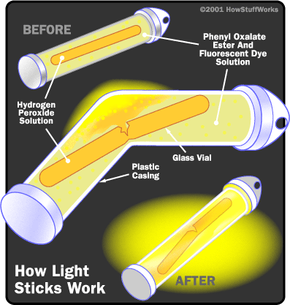
A glow stick consists of a glass vial, containing one chemical solution, housed inside a larger plastic vial, containing another solution. When you bend the plastic vial, the glass vial breaks and the two solutions flow together. The resulting chemical reaction causes a fluorescent dye to emit light.
A glow stick houses two chemical solutions, which give off light when they're combined. Before you activate the light stick, the two solutions are kept in separate chambers. The phenyl oxalate ester and dye solution fills most of the plastic stick itself. The hydrogen peroxide solution, called the activator, is contained in a small, fragile glass vial in the middle of the stick.
When you bend the plastic stick, the glass vial snaps open, and the two solutions flow together. The chemicals immediately react to one another, and the atoms begin emitting light. The particular dye used in the chemical solution gives the light a distinct color.
Advertisement
Depending on which compounds are used, the chemical reaction may go on for a few minutes or for many hours. If you heat the solutions, the extra energy will accelerate the reaction, and the stick will glow brighter, but for a shorter amount of time. If you cool the light stick, the reaction will slow down, and the light will dim. If you want to preserve your light stick for the next day, put it in the freezer — it won't stop the process, but it will drag out the reaction considerably.
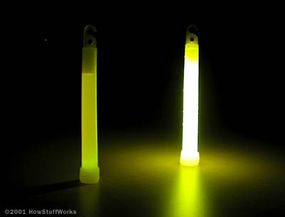
Heating a light stick will accelerate the chemical reaction, causing the dye to emit a brighter glow. The light stick on the left has been activated and kept at room temperature. The light stick on the right has been activated and placed in scalding hot water for one minute.
Glow sticks are just one application of an important natural phenomenon — luminescence. Generally speaking, luminescence is any emission of light that's not caused by heating. Among other things, luminescence is used in televisions, neon lights and glow-in-the-dark stickers. It's also the principle that lights up a firefly and makes some rocks glow after dark.