![]() |
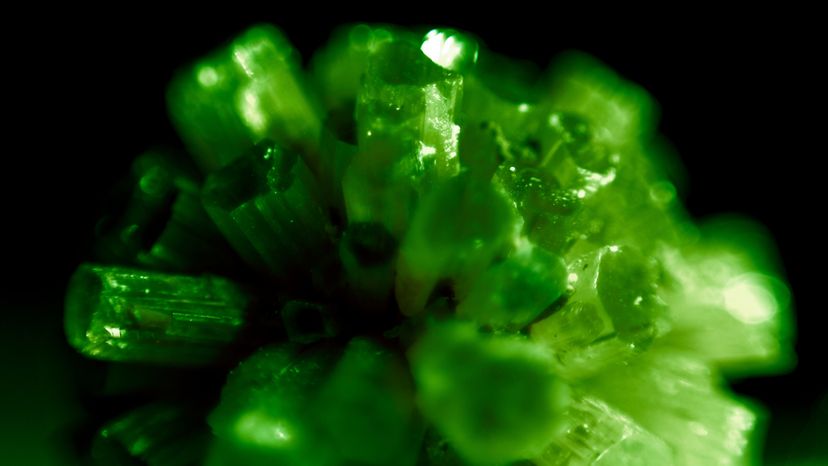
| Green kryptonite weakens Superman. See more superhero pictures. |
Just about everyone who grew up in the United States after the 1940s knows the core truth about kryptonite -- it's bad news for Superman. Most also have an inkling that kryptonite comes in different colors, even if they only heard about those colors on an episode of "Buffy the Vampire Slayer."
But if you ask the right person, you'll find out that numerous varieties of kryptonite have existed over the years, and different iterations of Superman have used them differently. Even if you restrict your question to the comic books, you can get wildly different answers. It all depends on the time period and title you ask about.
So what exactly is kryptonite? Where does it come from, and why is it here? What makes it so dangerous for Superman and other Kryptonians? And what does retcon have to do with it? In this article, you'll learn the answers to these and other questions about the radioactive mineral known as kryptonite.
Up Next |
In order to understand how kryptonite works, it's helpful to know a few things about Superman. Superman's home planet, Krypton, orbited a red giant star called Rao, about 50 light-years from the Earth. The planet was considerably larger than the Earth, so it had a much greater gravitational pull. In comic books from the late 1930s, Kryptonians all had super powers. However, in the current Superman universe, Kryptonians had no super powers -- Superman is only super because of the Earth's weaker gravitational pull and its yellow sun.
![]() |
A nuclear chain-reaction in its core caused a massive explosion, destroying the planet Krypton. Through the years, explanations for precisely why this reaction occurred have differed. In some older comic book storylines, Krypton had a uranium core. In the 2002 issue "Superman" #166, Krypton was creeping toward its sun, and the sun's immense gravity pulled the planet apart. The modern explanation is that a great war took place on Krypton, and a doomsday device known as the Destroyer started the internal chain reaction that destroyed the planet.
Just before the explosion, Kryptonians Jor-El and Lara outfitted their son Kal-El's birthing matrix for space travel. They sent Kal-El to Earth, where Kansas farmers Martha and Jonathan Kent found and adopted him. The Kents named the baby Clark, and he grew up to be Superman.
As Kal-El's birthing matrix traveled through space, it pulled fragments of the destroyed planet, made radioactive in the explosion, along in its wake. This radioactive debris became known as Green Kryptonite, or simply kryptonite, and it is deadly to super-powered Kryptonians. It does not react with oxygen, so it does not combust when it enters Earth's atmosphere. However, kryptonite is not invulnerable -- you can cut it, chip it, crush it and melt it with acid.
When exposed to Green Kryptonite, super-powered Kryptonians instantly become weak. With prolonged exposure, they die. Green Kryptonite has this effect because the interaction between two substances: its radiation and the Kryptonian's cells.
On Earth, a variety of naturally-occurring and manufactured substances emit radiation. They do this through one of three processes:
- Alpha decay: As an atom decays, its nucleus emits alpha particles, which are made of two protons and two neutrons.
- Beta decay: As an atom decays, a neutron in its nucleus spontaneously becomes a proton, an electron and a subatomic particle called an antineutrino. The atom ejects the electron and the antineutrino, and the electron becomes a beta particle.
- Spontaneous fission: An atom spontaneously splits into two atoms of two different elements. It can eject neutrinos when this happens.
- Tall ladders
- Curry and bridges
- Bell peppers
- Small talk
- Andie MacDowell and cilantro
- Crappy comic book movie adaptations
- E-mail chains
Atoms that undergo any of these processes often have lots of extra energy. They emit this energy as gamma rays, which are electromagnetic pulses -- they're made of energy, not matter. Each of these forms of radioactive decay creates ionizing radiation, which can knock electrons off of atoms. X-rays, another form of electromagnetic energy, are also a form of ionizing radiation. Check out How Nuclear Radiation Works for more information.
Relatively speaking, alpha and beta particles cannot penetrate very far into matter. Gamma rays and X-rays, on the other hand, can penetrate matter, including human bodies. Their ability to displace electrons from atoms can cause cells to mutate, sometimes causing cancerous tumors. Fortunately, lead blocks both gamma rays and X-rays. It's able to do so because of its high electron density. The rays are unable to penetrate the dense web of electrons found in a piece of lead.
Like radioactive Earth elements, kryptonite emits radiation, although exactly how kryptonite atoms decay is unknown. However, kryptonite radiation seems to behave like gamma or X-ray radiation -- it can penetrate objects and living bodies but cannot penetrate lead. This suggests that kryptonite radiation is a form of electromagnetic energy, like gamma or X-rays, rather than particles of matter.
We'll look at how this radiation causes its deadly effects in the next section.