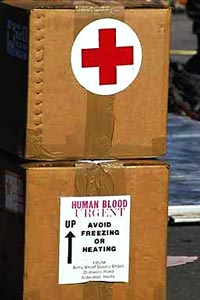
Do you ever wonder what makes up blood? Unless you need to have blood drawn, donate it or have to stop its flow after an injury, you probably don't think much about it. But blood is the most commonly tested part of the body, and it is truly the river of life. Every cell in the body gets its nutrients from blood. Understanding blood will help you as your doctor explains the results of your blood tests. In addition, you will learn amazing things about this incredible fluid and the cells in it.
Blood is a mixture of two components: cells and plasma. The heart pumps blood through the arteries, capillaries and veins to provide oxygen and nutrients to every cell of the body. The blood also carries away waste products.
The adult human body contains approximately 5 liters (5.3 quarts) of blood; it makes up 7 to 8 percent of a person's body weight. Approximately 2.75 to 3 liters of blood is plasma and the rest is the cellular portion.
Plasma is the liquid portion of the blood. Blood cells like red blood cells float in the plasma. Also dissolved in plasma are electrolytes, nutrients and vitamins (absorbed from the intestines or produced by the body), hormones, clotting factors, and proteins such as albumin and immunoglobulins (antibodies to fight infection). Plasma distributes the substances it contains as it circulates throughout the body.
The cellular portion of blood contains red blood cells (RBCs), white blood cells (WBCs) and platelets. The RBCs carry oxygen from the lungs; the WBCs help to fight infection; and platelets are parts of cells that the body uses for clotting. All blood cells are produced in the bone marrow. As children, most of our bones produce blood. As we age this gradually diminishes to just the bones of the spine (vertebrae), breastbone (sternum), ribs, pelvis and small parts of the upper arm and leg. Bone marrow that actively produces blood cells is called red marrow, and bone marrow that no longer produces blood cells is called yellow marrow. The process by which the body produces blood is called hematopoiesis. All blood cells (RBCs, WBCs and platelets) come from the same type of cell, called the pluripotential hematopoietic stem cell. This group of cells has the potential to form any of the different types of blood cells and also to reproduce itself. This cell then forms committed stem cells that will form specific types of blood cells.
We'll learn more about red blood cells in detail next.
Advertisement